
Insights — Blogs and Vlogs
Come gather ‘round people…
Come writers and critics…
Come senators, congressman…
Come mothers and fathers…
For the times they are a-changin’
Because Dylan was right, the topics our blogs and vlogs cover a lot of territory. They are diverse by design.

Dion Drew: An Amazing Man
Dion Drew: “When I help another person, it do something for me....


Newton Was More Right Than He Knew “…an object in motion remains in motion unless acted on….”
In Minneapolis for a convening to help build “an Intersectional Philanthropic Approach....
In Minneapolis for a convening to help build “an Intersectional Philanthropic Approach: Climate Change, Agriculture, and Healthy Rural Communities”, I am reflecting on a film we made in 2009. Hope in a Changing Climate premiered at Agriculture and Rural Development Day at COP 15, the goals of which are described below in the report from the International Institute for Sustainable Development.
“The key objectives of the meeting were to build consensus on ways to fully incorporate agriculture into the post-Copenhagen climate agenda and to discuss strategies and actions needed to address climate change adaptation and mitigation in the agriculture sector.”
Tom Vilsack, The U.S. Secretary of Agriculture, both then and now, addressed the group and “underscored that food security and climate change are linked and one cannot be addressed without the other.” The film went on to be broadcast globally by BBC World, received numerous awards, and was the impetus for gatherings and guided discussions in over 30 countries.
And now we are approaching COP … 29.
I thus can’t decide whether I am proud to be a part of this important meeting or dismayed that it has taken us so long to have such a joint convening of funders. Probably both. Congratulations are due to the leaders and staff of all the sponsoring organizations: Sustainable Agriculture and Food Systems Funders, Climate and Energy Funders Group, Funders for Regenerative Agriculture and the Health and Environmental Funders Network. Putting together something like this takes a ton of thinking, planning, coordination, and execution. And as has been the case with all previous SAFSF gatherings, I am sure it will be enlightening, spawn collaboration, and help move not just one but multiple needles.
But why has it taken so long to do this – to act? Surely it is not because participants don’t know one another. And while there is always some competition for members among philanthropic affinity groups, we are a generally collegial group and don’t operate in the “free” market that many would likely agree is the cause of serious environmental, climate, health, food, and agricultural challenges. And although resources are always scarce, it is also not for lack of funds.
The last 18-months has seen a host of positive announcements from USDA, ClimateWorks, Acumen and others; and the Global Alliance for the Future of Food, Rockefeller Foundation and additional organizations are pushing for deeper collaboration in advance of COP 29. Yet the question persists; why the lag from COP 15 to COP 29? I’m not sure of the answer, but I think it is important to reflect on how we arrived where we have, at the moment we have.
I propose for consideration what I think is a major obstacle that we need to overcome. Most of us are not trained as systems thinkers. Most of us don’t know the underlying principles that are used to design, understand, and fix systems. Many of us work in organizations where we encourage others, or are ourselves encouraged, to think outside the box. But very few of us have been charged with thinking about the systems that connect the boxes.
Despite our commitment to drive systems change, how many foundations have a ‘program officer for systems’? A member of SAFSF for quite a few years, I have been a regular irritant on this matter – and am excited that Clare Fox, the new head of SAFSF, spoke to the importance of systems in her opening remarks. While the language of systems change can seem opaque, it’s no more daunting to understand system dynamics and hierarchy or mental models than it is to come to terms with carbon sequestration, glyphosate, or nutritional deficiencies. It is helpful when trying to change systems to understand the differences between a fulcrum, a lever, and a leverage point. Whether our vocabulary defines our thinking or our thinking defines our vocabulary, it’s hard to change systems unless we understand them.
Let’s set some targets.
A webinar series for foundation trustees and leaders on the fundamental of systems thinking;
Advanced training in systems design for a staff member;
Guest speakers at annual conferences who focus on systems design and change; or
A digital and curated library of materials on systems thinking.
I am sure other folks will have better ideas for how to overcome this obstacle. But, please, let’s not wait for COP 40.
Watch the full-length version of "Hope in a Changing Climate"
(Courtesy of Plant for the Planet)
On Flags and Fascism
I cannot continue to fly the Israeli flag. With apologies to The Grateful Dead....
I cannot continue to fly the Israeli flag.
With apologies to The Grateful Dead, ‘what a long, strange trip’ it has been since Russia invaded Ukraine in 2022. That is when I hoisted the Ukrainian flag in front of my house and put 200 little Ukrainian flags on my lawn with a note inviting neighbors to please take one if they wanted to show opposition to a ground war in Europe in the 21st century. Although they have faded now, they were all taken and planted around my neighborhood in Maryland.
I had offices in Ukraine before and after the break-up of the USSR, have travelled to many of the cities now devastated by war and had arranged for Western news crews to visit the now precariously operating nuclear power station in Zaporizhzhia.
While Putin denies complicity in the death of his most successful, outspoken, and globally recognized opponent, Alexei Navalny, Trump admonishes European nations to ‘pay their bills’ to NATO and invites Russia to invade those countries that do not. This bombast from the leader of a party once led by Dwight Eisenhower and Ronald Reagan is beyond bizarre. But it is equally mind-bending from a man who has rarely paid any of his bills with his own money but has instead masterfully extracted money from a seemingly endless stream of gullible investors, campaign contributors, students, and customers to pay his own bills. Whether his reduced bond will stand or fall remains to be seen.
As Trump’s fealty to Putin, and the Republican leadership’s fealty to Trump can no longer be a surprise, a speaker at the recent “Conservative” Political Action Conference (CPAC) takes us a step further into the theatre of the absurd. From the stage as part of a panel chaired by Steve Bannon. Jack Posobiec gleefully welcomed participants to “the end of democracy. We are here to overthrow it completely.” He went on, excitedly explaining that “we didn’t get all the way there on January 6th but we will endeavor to get rid of it and replace it with this…” He then holds up a cross on a necklace and Bannon responds, “Amen.” And this unabashed white supremacist and antisemite continues: “all glory is not to government; all glory to God.”

Last October I hoisted the Israeli flag after Hamas terrorists massacred and brutalized more than 1,000 Israeli citizens. Then I added the peace flag which was an ever-present symbol of the 1960s and ‘70s, often at Grateful Dead concerts. And then I cut the Israeli flag into tattered strips, reflecting what Israel’s current leaders have done to the moral fabric of the nation.
Then I added the Keffiyeh, the traditional head scarf that was worn proudly in the past by Palestinian villagers and farmers to distinguish themselves from more urban Palestinians (and to deflect sun and sand). Yasser Arafat the founding leader of the Palestinian Liberation Organization brought the Keffiyeh into global focus and was awarded the Nobel peace prize alongside Israeli leaders Yitzhak Rabin and Shimon Peres in 1994.
When I added the Keffiyeh, I offered my neighbors an explanation, with a little note on the lawn: “If you are wondering, I would love to fly another flag that would let me distinguish the horrific suffering of the Palestinian people from the horrific acts of the Hamas organization.”
I posted another little note eight years ago, in November 2016, after Trump was elected -- but on twitter rather than my lawn: “We elected a fascist and are all now part of a reality TV show. Facts are props. Citizens are just viewers, audiences to be manipulated.”
While that tweet will continue floating around the digiverse, the Israeli flag no longer flaps in the Spring wind near my front steps.
Connections in a Fractured World: Vivek Murthy, Crimea, and Gaza
In a world that seems increasingly fractured, what connects us – as people....
In a world that seems increasingly fractured, what connects us – as people, as teams and as communities? How well we understand the complexity of connection may hold the key to unlocking success.
For young kids at Mundo Verde Bilingual Public Charter School, a connection to the earth and to changing things for the better fosters a sense of connection, even as 4th graders. We worked closely with the CBS NEWS crew that produced this piece about this long-term client that was broadcast 240 times in 40 states in late October.
Hope for a better future, whether via individual opportunity or systems change, can also meet our species-level need to engage with others. Social science research makes clear that creating opportunities for other people is a twofer; the creator and the beneficiary both win. We worked for years with New York State’s first registered benefit corporation, Greyston Bakery. Dion Drew tells the story of Open-Hiring better than I can. (And a little bit of sugar helps too!)
From a bakery in Yonkers, NY, to a climate conference in Europe working to solve a common problem also enables people to live the experience of the whole being more than the sum of the parts. See the short film we executive produced.
Yet, despite years of successful collaboration between Israeli Jews and Palestinian Arabs (through organizations like Seeds of Peace, New Israel Fund, The Jerusalem Youth Chorus and others), the Arab-Israeli conflict has bound them together in mortal combat. As David Shipler writes, “The two peoples are imprisoned by history”.
Root cause analysis of this seemingly intractable conflict is eerily similar in two respects to the war in Ukraine: property and religion. Jerusalem is claimed as the homeland by Jews, Christians, and Arabs. The prophet Mohammed is thought to have arrived there in the 3rd century C.E. Jesus is believed to have been a preacher or Rabbi in roughly 30 C.E. King David and King Solomon are thought to have ruled Palestine in roughly 1000 B.C.E. Sharing, or the inability to share, is yet another form of connection.

Also bound together by shared borders and history, the war that Russia initiated in Ukraine can be traced back to 988 C.E. when Grand Prince Volodymyr (in what is now Kyiv) embraced the Eastern Orthodox branch of Christianity. In 1054 The Great Schism then solidified the split between the Church of Rome (Roman Catholicism) and the Church of Constantinople (Eastern Orthodox). From Tsarist times, the ‘gathering’ of all the regions embracing Eastern Orthodoxy (and eventually the Russian Orthodox Church) has been a spiritual quest for Russian leaders. And since even before the creation of the USSR, Russian leaders have been on an almost equally spiritual quest for a warm water port. Think Crimea. Think Jerusalem.

Enter Vivek Murthy. Born in Yorkshire, England, of Indian descent, who released in May of this year, “The Surgeon General’s Advisory on the Healing Effects of Social Connection and Community.” The essence of the warning is quite clear: “(s)ocial disconnection puts us at increased risk for depression, anxiety and suicide, as well as heightening our risk for stress-related physical ailments like heart disease, stroke and dementia.”
And a month later, his office released "U.S. Surgeon General Issues Advisory on Social Media and Youth Mental Health.” It will shock no one that “(f)requent social media use may be associated with distinct changes in the developing brain in the amygdala (important for emotional learning and behavior) and the prefrontal cortex (important for impulse control, emotional regulation, and moderating social behavior), and could increase sensitivity to social rewards and punishments.” The promise that Facebook dangles in front of us to “give people the power to build community and bring the world closer together” may be no more than a hallucination of an oasis of peace appearing on the horizon in Sinai. Or could it be more?
Connections need to be managed. This is why counselors advise that there are three players in every partnership between two people: you, me, and the relationship itself. Intent and purpose are essential for successful connection. Misperceptions and competing narratives will lead to unhealthy connections – more traps than links. Whether you are managing a personal relationship, building a brand and protecting a company’s reputation, committed to better understanding the thinking and behavior of key stakeholders, or wrestling with why collaboration across departments often don’t work harmoniously; in all cases how well or poorly we manage our connections will determine whether they buoy or burden us.
Brittle Systems: Staying Connected in the Post-Pandemic Era
My experience this week at Heathrow is a small but telling example of....
My experience this week at Heathrow is a small but telling example of the global risk many businesses face: multiple systems failing simultaneously. Solving discrete problems is what we do every day, at home and at work. Resolving the failure of a system is much more challenging. However, coping with the failure or near failure of interwoven and codependent systems can lead to catastrophic grid lock.
Heathrow reminded me of airports I used regularly running my business in the Soviet Union – minus the stray dogs and birds inside the terminals. In both settings people were working mightily to succeed despite multiple systems failures.
A common feature of systems failure is a disconnect between people with and people needing information. Communications collapses often go unseen until they spill over either into another business function or into the public domain. The most disturbing and compelling explanation of this may be Edward Tufte’s iconic analysis of how the likelihood of “O-ring” failure was missed in a jumbled PowerPoint slide before the Columbia shuttle burned on re-entry. (PowerPoint Does Rocket Science--and Better Techniques for Technical Reports)
Although inconsequential by comparison, massive crowding, low ceilings creating a cloud of noise, and awful or completely missing signage at Heathrow meant that hundreds of people in line for dozens of flights could not hear agents shouting. They were trying, in vain, to pull people who were at risk for missing flights from lines that started well outside the terminal building. While waiting, we asked ourselves numerous times: “What did she say, was that about Dulles or Dallas?” It should have been obvious to on-site managers that shouting indecipherable instructions in an overcrowded, international airport was going to fail, especially while competing with booming public address system broadcasts of clear but useless instructions about unattended bags.
We received repeated false assurances not to worry because there was a back-up plan -- to supplement the verbal communications with written signage. “We will come around with boards.” But just like the inaudible audio, when agents did finally mingle with the crowd, they were hugging the signs rather than raising them overhead. For different reasons, in instances, people with important information could not get it to people who needed it. The information was known, the users were known; they never connected.
Working around these communications failures, based on experience (always the genesis of workarounds), we managed to get into a short line to a check-in. But when it was our turn, the agent announced that she was closed, I flashed to a surreal scene decades ago in the Soviet visa office in Washington, DC. As I would talk to a consular office behind a glass partition, sliding papers and passports through a little metal tray. If a discussion was not to the Consular officers liking, s/he cut it off. Abruptly, by pulling a curtain down over the window. Conversation done. In this instance at Heathrow, again, information black out.
Despite these obstacles, we finally did make communications work. We told an agent, she found a supervisor, the supervisor phoned the gate, reached someone, received the correction information; they had just closed the gate. By definition, workarounds always come back at some point to rejoin the system that they were avoiding. They are detours, not replacements.
Next stop, customer service for rebooking and a place to stay overnight. Another system, equally brittle, equally on the edge of collapse, and also intertwined and codependent. As required by policy (a system of words), we were told that rebooking is done through a consortium of hotels that service the airlines. Booking a place myself was not an option – well, not an authorized option. She logged into the booking system. She emailed the system operators. No result from either. She emailed again.
While doing all this she was also regularly reaching behind her monitor into a tangle of cables. Since we had more than enough time together (way more!), I learned that this was to switch screens on her single monitor. Again, memories of what in Russia, in the 90’s, we called ‘sneakernet.’ Before networking software enabled multiple computers to share printers, we put together a manual mechanism. If you needed to print, you walked over to the printer and manually flipped a switch that enabled the printer to receive signals from a designated computer. In Russia. In the 1990s. And at Heathrow in 2022.
Finally, she called the consortium operator. After a brief conversation, the agent at the airline consortium for hotel booking hung-up on the airline customer service agent. A digital version of the shade being pulled down in the Visa office. Sensing that I was inside a system on the edge of collapse (as I was in the USSR when it did officially collapse), I mapped a workaround. Calling various airport hotels, I found one with an opening and booked a room. While the consortium booking system was still failing to generate the needed output (a hotel reservation), I let the agent know I had a room. Long story shortened; we then bartered my reservation for her authorization to rebook – which she shared with me by – wait for it – using my phone camera to take a picture of her computer screen.
In a sense, who cares about my experience at Heathrow? We all know airports are a mess. But the mess is much more important and bigger than my experience. Our systems today are so complex, human/machine interactions are sticky rather than smooth, and workarounds are fast becoming the norm. Fragile systems on the edge of collapse are incredibly risky. It’s unsustainable for business because, especially in tight margin sectors, you can’t keep sending flights out with seats empty because passengers could not get through the airport, then occupy a second seat on an additional flight, pay for overnight accommodations, and absorb the snow-balling transaction costs of all these adjustments – in addition to reputational costs.
Transforming systems that are fragile and critical and are regularly right on the edge of gridlock is one of the most critical and daunting challenge of the Post-Pandemic Era (PPE, again). Complex systems fail in complex ways. We cannot fine-tune or tweak our way out of this challenge. We must act.
First, systems thinking cannot remain the relatively obscure discipline that it is today. We need to pull systems training out of engineering schools and build it into our primary, secondary, and executive education institutions.
Second, companies need to come clean about the various systems used to shift costs to customers. We need to understand externalities. By way of a tiny example, the time has come to pull back the curtain on the façade of “your call is very important to us.” Companies have cut staff, reduced training, and invested in technology rather than people to reduce costs – maximizing benefits to owners and imposing costs on customers. As consumers, we have all become unwitting accomplices in shifting the cost of selling ourselves the services being offered. It’s a neat trick. But especially for companies with ethical pledges, commitments to socially responsible behavior, and a dedication to mission beyond profit the externalities charade needs to end.
Third, we need to study joints. Let it be the awareness that connection points between interlocking systems are extremely fragile. And when they fail, risks multiply. And fail they will. It is these in-between spaces, the joints that hold systems together, where failure is most likely. That is as true for O-rings on the Space Shuttle as it is for tiles in your bathroom, or the white space on organizational charts.
The handwriting is scrawled across the wall tiles. We have been warned.
Putin and Trump: At War with History
I have never been to the Russian Air Base on the Eastern edge....
I have never been to the Russian Air Base on the Eastern edge of Ukraine in Millerovo, where attack helicopters, tanks, armored personnel carriers, and ground forces have begun the Russian invasion. The last time I was in eastern Ukraine, in Luhansk (about 60 miles from Millerovo), I visited a military plant that was then converting to syringe manufacturing. I was with Yuri Shchekochikhin who represented the region as a member of Parliament.
Yuri is dead now; murdered by the Putin Regime for telling the truth. Perhaps the most courageous leader of independent journalism in the former Soviet Union, he was poisoned before either Anna Politkovskaya or Aleksandr Litvinenko. I’ve been reflecting on our time together in Ukraine and Russia, and as his host at my home when he first visited the United States. I will always remember his sweet incredulity that after I made a quick phone call to a local Chinese restaurant, a man on a bicycle arrived with dinner. Yuri closed his big round eyes and slowly shook his head in disbelief.
Over many years and more than a few vodkas, Yuri and I became friends. I remember him tugging at my arm in a Moscow hallway, excitedly explaining that he had interviewed the FSB agents (formerly KGB) who carried out the order to bomb apartment buildings in Russia - a false flag operation to garner support for military suppression in Chechnya. It was my turn to look at him, incredulous; ‘really,’ I asked? ‘How can you be so sure?’ He looked at me with his soulful eyes and short, cropped hair and leaned in: “They told me, the ones who did it; they talked with me, the agents; I interviewed them.”
In that same region of Eastern Ukraine that Yuri once represented, Russia has issued papers to nearly a half-million residents - officially identifying them as Russian citizens. If ‘provoked’ by some horrible slaughter of these innocents, it would not be the first time Russia sacrifices its own. Or as now seems equally likely, he may just recognize the two regions as part of Russia.
But really? Why, we ask? What is Putin thinking; what does he want that he is willing to risk so much? This is not fundamentally about his thinking but about the feelings deep in his Russian soul. He yearns not only for the warm-water port Russia has sought since Peter the Great (which he has now secured in Crimea). He is driven to repair a profound affront to Russian exceptionalism. His quest is to remake Kyivan Rus’ and repair The Great Schism - the spiritual and religious split in 1054 between Rome and Constantinople that has given us what we now understand as Eastern Orthodoxy in contrast to Roman Catholicism.
This is less about Ukraine as a runaway Soviet Republic, and more about Putin trying to roll back 1000 years of history. Comparatively, Trump is a piker. But the January 6th attack on the US Capitol was without question an attempt to rewrite American electoral history. Both these political strongmen understand that the power to rewrite history is also the power to shape the future.
Democracy is resilient and can better withstand the forces of autocracy than can the valiant but vastly outmatched Ukrainian military. Democracy in America won’t just collapse like an apartment building.
But the marauders on the Capitol steps operating as paramilitary units (and equipped as such), Putin with control over a vast military and propaganda apparatus, and Trump in his pathological lying and fanaticism all share the same disdain for history when it stands in the way of their dystopian visions for the future. It was because of his hope for a better future that Yuri was determined to tell the truth. And alongside the catastrophe unfolding on the ground in Ukraine, truth itself has also suffered a terrible blow.
More than geography is at stake in Ukraine.
The Black Swan of Trumpist Insurrection, Part I
This would be my 2nd coup d’état. My first was in Moscow, when I witnessed....
This would be my 2nd coup d’état. My first was in Moscow, when I witnessed Russian tanks opening fire on the Russian Parliament. Label attackers of the United States Congress what you will: terrorists, revolutionaries, insurrectionists, rioters, a marauding mob. Despite the Department of Defense characterization of this as merely a “first Amendment protest,” whatever we name it, this trauma has forever changed personal and global understanding of democracy in America.
Our mindset, the mental window that frames our understanding of the world around us, has cracked. The fight over how to understand what has happened is the battle for the future of the country. And in this, the war of words matters. Need we more proof than Trump of the power of language: “this is just the beginning,” “good people on both sides”? Calls for “unity” and “moving on” from criminals and the criminal minds that energize them are perhaps even more damaging to the nation than the tragic loss of life and the surrender of the Capitol. How we understand and internalize what happened becomes the reality we carry into the future.
Neural networks shape and reshape our minds. Our perceptions evolve, memories morph, patterns develop, and pathways become more fixed with repetition. Systems of behavior, habits, become harder to change. Fights over how to define a ‘new normal’ cause personal pain and stress systems that have not been designed to be resilient.
What we see and what we cannot see are products of our mindsets. The attack itself-- fomented by an unhinged, megalomaniacal, vengeful, and emotionally stunted con man—turned on the successful peddling of a myth about election fraud. Weaponized, that myth infiltrated the softened minds of fearful people looking for a villain. Any villain. Social media, of course, was just a delivery tool, the syringe that injected the poison.
Fear, collusion, and incompetence are a deadly combination. That we couldn't defend the Capitol from an insurrectionist mob was a failure not of intelligence but a failure to be intelligent. The handwriting was not on the wall but displayed as a flashing neon sign and announced in advance. There was time to design, produce and sell sweatshirts for Trump's "be there...be wild’ event! That a white mob would beat to death a Capitol Police officer on the steps of the U.S. Capitol in broad daylight was so outside the realm of the believable that flashing lights were not seen.
There is a system in America, a systemic ‘unseeing’ of our body politic’s birth defect. Systemic racism has enduring power because it is embedded in the frameworks of our mind. And because that has been true generation after generation, the social operating systems we have built reflect that mindset. And still, many of us remain ‘unseeing.’
The façade of ‘this is not who we are’ crumbled this week. The curtain has been drawn back for all Americans to see. As sure as the confederate flag was paraded through the Capitol, the plotters, their henchmen, and their apologists are now scrambling to whitewash this. The future of democracy in America depends on whether or not we permit them to airbrush this trauma out of our collective minds or redesign the social, economic, and political systems that we have built.
Middlemen or Distributors?
Now we all have personal experience with the collapse of supply chains....

Now we all have personal experience with the collapse of supply chains: toilet paper, produce, meat, flour. They are more fragile than we knew, for many reasons. Whether in conversation with my consulting colleagues at Council Fire or with my clients such as the Equitable Food Initiative, supply chains are front-of-mind – as they also are in many everyday conversations.
Supply chains manage ‘betweens,’ the spaces between activities that otherwise would be disconnected. They connect the farm to the packing house, packing to trucking, truckers to warehouses, and so forth. When working properly, these supply chains are tightly connected, like individual railcars that together make up a train.
While the couplings that keep a train together are obviously critical, do we need all the couplings in our supply chains? When families go berry picking on a local farm, there is no fresh produce supply chain. However, when a farmworker in New Zealand picks a kiwi for sale in Detroit, the chain is long and winding (more of a web than a chain, in fact).
Distributors and consolidators are either essential to keep supplies humming or they are middlemen squeezing growers or producers without adding enough value to warrant the cut they take. Especially today, they seem critically important. But as we rebuild, should they play the same traditional roles or not? Fishmongers are now making a go of it in the UK selling straight to customers at the dock; no distributors. Restaurants have become community pantries in the Washington, DC, area; new distributors.
Size and distance are dispositive. We can't have lobster in the winter in Oklahoma without a complex system of suppliers carefully coupled together. While most of us are not going back to the farm, or to lobstering, maybe the real innovation obscured by the much bandied about idea of ‘scale,’ is that smaller might be better than bigger. We misuse scale as a synonym for bigger, when it actually means proportional or appropriately sized.
As we rebuild better, size and distance must be central to planning. Going from the bedroom to the home office is a shockingly short commute for many people. And we don’t even need to embrace Small Is Beautiful as a principle to wonder; what really is the optimal size for the most efficient economic system?
Before we scoff at alternatives that emphasize regions and internalizing costs, sharing economic value more fairly and better alignment with our personal values, we would do well to remember that what is dismissed today as ‘unworkable,’ is tomorrow’s patent and next year’s most successful IPO.
Especially today, be careful betting against big changes.
------------
* Council Fire is a global management consultancy that helps purpose-driven organizations thrive by creating lasting economic, social, and environmental value.

This Ain’t That – Communications & Covid-19
Every crisis is of course unique and demands specialized communications….
Every crisis is of course unique and demands specialized communications. But regardless of scale, or location, or type, common features emerge - whether Chernobyl (Ukraine) 9/11 (NYC), Bhopal (India), or the Tsunami that took ~30,000 lives in Sri Lanka in 2004.
Across these diverse events, each had a precise start, a field of impact that could be defined, and a timeline. Water and wind move at known rates. Fissile nuclear materials decay in predictable ways.
These ‘typical’ crises burst forth as a single events – a tectonic plate shifting under the Indian Ocean, a terrorist attack. And each had an ‘owner’ upon whose desk responsibility for communications (if not also for the event itself) crash-landed.
Not so Covid-19. At different times in different places Covid-19 began, has begun, is beginning or will begin. And the endpoint, as well as the metric to measure it, keeps moving: flattening the curve, getting back to business, declining mortality rates, testing, vaccine, treatment.
Adapted for these circumstances, I thus offer as fundamental the following ten #communication links, with descriptive text below the graphic.

First and foremost, especially now, start by examining your....
Assumptions: Revisit them all. No exceptions. Review who you and your organization want to be in this moment. Auto assembly line or ventilator shop? Fashion house or PPE manufacturer?
Knowledge: Don’t join the chorus. Know what you know and don’t stretch. That everyone’s life and work has been affected does not make everyone a specialist. Lean hard on your unique and value-added knowledge.
Audience: Move past traditional understanding of your target audience. Know what is different today about the people you need to reach. People are craving connection and structure, trying to navigate in a world turned upside down. Can you help?
Narrative Arc: Don’t fight the dominant virus #narrative unless your platform is equal to the task. Jujitsu-style, draw energy from a discrete element of it and then align with that thread. Identify that singular connection carefully and stick with it. Flip negatives to positives, but don’t distort or dissemble.
Messaging: Announce whether you are offering or asking. Say something that has not already been said or if reinforcing a point be explicit about why you are doing so. Be hyper-clear. Be brief. Make two points rather than four; shorten three paragraphs to one.
Services/Products: Stay off the shoulder so emergency vehicles can pass. Don’t reposition something as essential that isn’t. Announce what's inside – whether on a truck or in an email subject heading. For shipped products, add ‘handling ingredients’ to make clear if packed by hand or machine.
Pathways/Delivery Vehicles: Mental, technical, and operational bandwidth are all reduced. Reconsider the optimal way to deliver your message. Create ‘learn more’ options. Take the time to make a visual really bounce so you can cut text. Be consistent. Be consistent. Be consistent.
Timing: Time has become warped, days merging into one another; we are wobbly and off our stride. Date and time everything, even if evergreen. If you don’t need to push now, don’t. If you can postpone, postpone. Accept that everything will take longer. No exceptions.
Calls-to-action: When feasible, flip asks into offers. Help more; ask less. Lower the bar for participation and contributions not directly linked to the crisis.
Impact: Holding your own in this #crisis is a success. Limit your own and stakeholder expectations.
Assessment: Rethink metrics. Expect web traffic to fluctuate dramatically. Memorialize more than usual; keep timelines. Make it easier for your audience to provide feedback.
One principle, however, remains fundamental. Listening, not talking, remains the bedrock of sound communications.
A Vision From Farm to Fork: What A Strong Regional Supply Chain Looks Like
Following sessions with the Global Alliance for the Future of Food (NYC) and….


Following sessions with the Global Alliance for the Future of Food (NYC) and The Emerson Collective (CA), Jonathan J. Halperin addressed the audience at The Chesapeake Food Summit (DC), urging participants to let go of the myth of a “neat, clear, linear supply chain.
"It’s a web, a network, a system. We all need to think systems. Systems connect silos.”

What They Talked About in Helsinki.
Helsinki was not an aberration. Trump is many things. Stupid is not one of them….
Note: The fiercest competition today is for attention. More than any other, this is the market that counts. Dominate the market for attention and you wield a kind of power rarely seen across business, politics, and culture. As exemplified in the Trump Administration’s dizzying attacks, reality itself is under assault. The institutional cornerstones and conceptual underpinnings of democracy are profoundly at risk. Even as new revelations emerge every day, what we might call “The Helsinki Moment” is instructive. This dispatch thus looks somewhat wryly at change, shock, power, partnership and the limits we often place around our own imagination – of both the future and the past.
Helsinki was not an aberration. Trump is many things. Stupid is not one of them. It is time we stopped being shocked.
Trump and Putin share common goals and values: absolute need for loyalty, disdain for free and fair elections, willingness to use and discard people, and antipathy toward media. As has been well documented, they are also both vengeful, racist, misogynist bullies. They are united in a relentless drive for power amassed in all its forms: financial, institutional, political, and control of natural resources. The goal is clear: engineering the collapse of democratic institutions and societies around the world.
Trump is not so much Putin’s toady or agent as his enthusiastic partner.
The core topic in Helsinki was how well they are doing in this collaboration to bring forward their vision of a world run be authoritarian despots: elected, stable, geniuses as they fancy themselves.
The dust will not settle after Helsinki; and we will not return to the established norms of diplomacy, democracy, and allegiances. Helsinki was, rather, a harbinger of things to come. Trump is not going to now start reading briefing books; he is not going to repair relations with America’s allies of the last 75-years. Those relationships are finished.
Helsinki was intentionally announced publicly yet held privately to send myriad signals and warnings to foes as well as allies, to confidantes as well as would-be challengers. It was intended to and did serve to intimidate. And make no mistake, the reactions were carefully monitored – like political sonar, taking readings, to chart the next move. I spent 17 years working in the Soviet Union and post-Soviet Union with major western companies; this is a well-honed technique.
Understanding Putin and Trump as collaborators allows us to bring more clearly into focus the likely discussion points in the Helsinki meeting. On foreign affairs, the Middle East, Syria, Iran and Israel’s regional capabilities were center stage with discussion of who can tolerate what levels of military intervention where; timetables and sequence of military and diplomatic actions; and possible puppets, spokesmen and how to sow division among opposition parties. There was discussion of the need to perhaps instigate an action just provocative enough to warrant a pre-planned response.
Trump was also no doubt cautioned to manage his open disgust for German Chancellor Angela Merkel and to not be too hard on Putin’s all-important Gazprom – the global tentacles of which are essential to Putin’s apparatus.
On trade, aluminum, oil and natural gas figured prominently. Various commitments were made to ensure the ongoing allegiance of oligarchs such as Oleg Deripaska. Putin also pointedly reminded Trump that the global price of oil determines the state of the Russian economy. The stability and vulnerability of stock exchanges was also likely discussed – as these centralized markets are a juicy target. If one aims to shift the concentration of wealth on a global scale, well-timed stock market manipulation can accomplish quite a lot.
In the same vein, intelligence and propaganda was a theme threaded through the entire meeting. Putin shared some of his more refined propaganda techniques and urged Trump to develop a bit more patience -- to reduce his vulnerabilities, to manage some of his impulsivity. But Putin was sure to feed the American president’s ego with praise and admiration. Putin’s ability to read Trump’s body language (crossed arms, upraised eyebrow, tilted head) no doubt helped him find the right combination of ego-stroking and unsettling bluntness. Once a KGB agent, always a KGB agent.
Although not explicitly discussed, there was also clear recognition of the critical need to control data, access communications infrastructure, and manage the media. The combined power of post-Soviet intelligence operations, the porous security safeguards around US social media, and Trump’s power to access government databases was referenced as a key strategic asset of this new collaboration. Satisfaction was expressed at the prospect of a unified Russian/American monitoring, surveillance, and tracking system. With both leaders sharing a common desire to extract revenge against those who cross them, the energy around this unparalled capacity was palpable.
Putin no doubt praised Trump for conducting the various tests, for floating various trial balloons, such as encouraging the killing of journalists, not commenting when it happens, and maintaining ‘plausible deniability’ throughout. The use of ICE as a never-before seen U.S. internal security force was discussed and Putin provided suggestions and guidance to Trump for how to allow other figures to have just enough oversight that they can become targets of blame if things get out of hand. Trump expressed relief that the horrific images of kids in cages had vanished from the pages and screens of American media.
Trump complained mightily to Putin about the American judicial system continuing to be an obstacle in his efforts to rule -- as if a King or a Tsar, by proclamation or tweet. Putin praised for managing Justice Kennedy’s departure, keeping largely unnoticed connection to the critical Duetsche Bank loan by Kennedy’s son when Trump badly needed a billion-dollar cash injection. While the question of Trump pardoning himself was danced around, there was clear acknowledgement by both leaders that it was important to preserve the facade of an independent judiciary. Trump asked Putin if he wasn’t impressed also that the justice department switched direction just this month so that 501(c)4 organizations like the NRA no longer need to reveal donors. A knowing wink was exchanged.
Around guns and violence, they joked about how fun it would be to go hunting or at least to a shooting range, maybe bring some sexy girls, some vodka and beer, and have a little respite from the stress of leadership. But they moved on, speaking of girls; Butina. It was a good ploy, they agreed, to throw her away and see how the various institutions in the US responded, to garner intelligence on how much Mueller really knows. They considered if it would be needed to engineer some kind of quid pro quo personnel trade. Trading a girl who offered sexual favors to gain access in return for protecting Ambassador McFaul would be a delicious way for Trump and Putin to smear the good name of a diplomat – and yet appear that Trump was protecting him. Snowden was also briefly mentioned.
How to manage key assets was discussed extensively. And as part of a designing a pretext for announcing a joint Russian/American intelligence operation, various risk scenarios were reviewed. The pros and cons of creating and planting evidence, or digital footprints that would warrant investigation in Montenegro, or one of the Baltic states or in Ukraine/Crimea was also discussed. What would be the right level of crisis to engineer such that it would not spin out of control but be sufficient to further justify the collaboration?
Trump complained that he was beginning to be uncomfortable with the dance around election manipulation; if the hijacking of the 2016 election actually happened, then it might well be traced to someone ‘other’ than the Russians. Putin signaled empathy and understanding, agreeing that this trope might need to be refreshed as Trump has indeed referenced “other” quite a lot in this context. He promised to have his “boys” at 55 Savushkina Street in St. Petersburg look into some new messaging options that might reverberate well in social media.
Plans for hacking the 2018 elections were discussed and Putin thanked Trump for sending the Republican delegation to the Kremlin. Trump sought advice on the November 10th military parade in Washington, coming so soon after the elections on the 6th. Would it be too much for Putin to visit Washington and also view the parade with Trump? To what extent should Trump explicitly call for his base of armed supporters to descend on Washington to celebrate the mid-terms and militarize the Capitol? Acknowledging that this might be too “Soviet-like,” they agreed to wait a bit before deciding.
Near the end of the extended private meeting, Putin asked after Trump’s children and Melania’s health. With his arm a little too tightly around Trump’s shoulder, and in rather good English, Putin repeated his past reassurance; ‘I have no plan, absolutely no plan, to let the media know that we really did hack the election. No plans whatsoever.’
And thus, he reminded Trump that the compromising material he has is not sexual but existential. Putin can declare Trump a ‘loser.’
Jonathan J. Halperin managed a strategy and communications company in the Soviet Union and former Soviet Union for 17 years.
Markers of Corporate Purpose, Part II
Purpose seems to be catching fire. Empowered by yet another horrendous....
Purpose seems to be catching fire. Empowered by yet another horrendous school massacre, students from Parkland have changed the American conversation in a momentous way. The impact ranges far beyond the overdue debate on controlling assault weapons in the United States.
Companies once seemingly isolated from the issue of guns are being swept into an already heated discussion of corporate purpose.
Ed Bastian, CEO of Delta, grabbed the headlines recently with his assertion that “…our values are not for sale,” after the Georgia State Legislature showed its values by yanking a tax-break for Atlanta-based Delta after the airline succumbed to pressure and cancelled a group travel discount it had offered NRA members.
Larry Fink, Blackrock CEO, earlier wrote a letter that earned him kudos for championing a view that would not long age have been generously dismissed as quirky: “To prosper over time, every company must not only deliver financial performance, but also show how it makes a positive contribution to society.”
And not to be left out, CEO André Calantzopoulos, head of Phillip Morris, the company that once epitomized corporate malfeasance, announced a plan for the company to go “smoke free: …we have a duty to our business that we ensure we have a viable business going forward, so we’re investing in alternatives so we provide a future for them, as well.”
In the first blog of this series I shared some views on how companies are finding competitive advantage in purpose. This is not a passing fad. It has potency but not because big organizations are getting on a bandwagon. People, not organizations, are driving this.
In purpose we find meaning; in meaning we find ourselves.
Let’s look carefully at the three statements above. The last is perhaps the oddest. The comparison of Philip Morris to Patagonia in the attached article from Sustainable Brands is startling. I imagine finding these two companies in the same bucket has the founder of Patagonia, Yvon Chouinard, either laughing or horrified – or both. Patagonia has walked the talk of being a purpose driven company since Chouinard begin making chocks and surfboards in 1973. Despite growth and expansion into mainstream apparel markets, Patagonia has continued to align its products and manufacturing, marketing communications, activism, and policy positions around an exacting and exemplary mission:
Build the best product,
cause no unnecessary harm,
use business to inspire and implement solutions to the environmental crisis.
Patagonia has also been a leader in the BCorp movement, a shift in structure that enables corporations to put purpose and profit on a level playing field. (For further discussion of benefit corporations see the first installment in this series.)
On the other hand, for well-on a century PMI has been a global leader in producing “cancer sticks,” i.e. cigarettes. Its mission couldn’t be more different:
to own and develop financially disciplined businesses
that are leaders in responsibly providing adult tobacco and wine consumers
with superior branded products.
Aside from the fact that it seems to have been written by a linguistic contortionist, it speaks not at all to social purpose, gives only a passing nod to being responsible, and makes clear the core purpose remains exactly what Larry Fink from BlackRock decries in his letter to corporate CEOs
Further exploration of Phillip Morris purpose leads only deeper into the circular double-speak. While boasting that it is “Designing a Smoke-Free Future,” the company “operate[s] 46 production facilities in 32 different countries and produce[s] over 800 billion cigarettes each year.” Phillip Morris is Designing a Smoke-Free Future” the same way Exxon-Mobil is building an energy future devoid of fossil fuels – as slowly as possible, only when under extreme pressure to do so, and in order to maximize near-term ROI for shareholders regardless of the long-term consequences.
Before assessing the BlackRock and Delta letters more closely, let’s map what a company needs to do to not just talk about but actually demonstrate purpose – and it is, after all, in the demonstration that leaders accrue enduring benefits to brand, team, stakeholders and shareholders. Building on terrific work done by Generation IM with HBS and KKS, here our ten Markers of Corporate Purpose™ that we use to measure whether a company has or is developing a purpose beyond profit.
People: staffing structure, benefits, wages, inclusion, training
Resources: finance and human capital
Culture: diversity, access, transparency
Authenticity & Trust: Stakeholder engagement, regulatory and legal
Trade-offs: patterns of decision-making
Governance: structure, board, collaborations
Advocacy: policy positions, campaign contributions
Communications: lobbying, advertising, marketing, reports
Alignment: products, purpose, operations, leadership
Sustainability: targets, integration, reporting
Like more commonly referenced genetic markers, these Markers of Corporate Purpose™ (MCP) are not promises of what will happen but rather indicators of propensity. Taken together, however, they offer a benchmarking tool for assessing purpose.
More on our Markers of Corporate Purpose™ in the forthcoming, third blog of this series.
So, how does Delta stack-up on these markers for purpose? While Ed Bastian has been widely praised for his statement that “…our values are not for sale”, has that praise been earned or simply bestowed on him because of the understandable heat in the post-Parkland moment? Reading all of his short letter gives me pause, especially around MCP #4 and #7. While “Delta’s intent was to remain neutral, some elected officials in Georgia tied our decision to a pending jet fuel tax exemption, threatening to eliminate it unless we reversed course. Our decision was not made for economic gain and our values are not for sale. We are in the process of a review to end group discounts for any group of a politically divisive nature.”
It seems Delta was not really leaning forward into a courageous moral stand at all. But rather it was cornered into having to defend its decision vis-à-vis the NRA due to the actions of the radical right wing in the Georgia, Republican-controlled legislature. And Bastian back-pedals further by placing the NRA on equal footing with other groups of a “politically divisive nature.” This is corporate hypocrisy at its worst in that the entire ‘moment’ is about the sui generis nature of the NRA. Its fanatical financial and political advocacy of a civilians right to possess weapons designed for use by the military is categorically unlike any other. He then goes on to further pander to the NRA, kowtowing before the 2nd Amendment:
And we are supporters of the 2nd Amendment(link is external),
just as we embrace the entire Constitution of the United States.
As indicated in the link to the NRA’s own website, the 2nd Amendment, of course, says nothing about assault weapons and conveys no absolute right to own guns, clearly predicating that right on the need to “form a well-regulated militia.”
While it has garnered some short-term publicity benefits from a nice turn of phrase, Delta has also set itself up to fall well below the ambitious bar it has now set for itself in terms of living its values. Delta’s Rule of The Road articulate a solid set of values; the potential for leadership and purpose is there – as yet untapped.
By contrast, Larry Fink’s letter is a powerful statement: precise, blunt, and sweeping in its call for a fundamental rethink of the very core of what business is about in the 21st century. As a letter I give it high marks indeed:
"…a company’s ability to manage environmental, social, and governance matters demonstrates the leadership and good governance that is so essential to sustainable growth, which is why we are increasingly integrating these issues into our investment process.”
How quickly and openly that integrating happens is the question before Blackrock, the world’s largest asset manager, with $6.288 trillion AUM. Is internal guidance being re-written so buy-side analysts factor purpose into their day-to-day decisions? Is compensation being reworked to reward the values lauded in the letter?
How this unfolds will tell the tale of whether Blackrock is only advising others or also going to walk its own talk. As Yvon Chouinard might have it, is Larry Fink just paddling or actually surfing?
Phones and Nuclear Power: The Network Effect Collides with the Tragedy of the Commons
The technologies we embrace reflect social and business values. But….
The technologies we embrace reflect social and business values. But whether they embody our personal values is another question entirely. Contrary to decades of myth-making about the inherent neutrality of technology – it is only a question of how we use it – values are embedded in many technologies, reinforcing some values while undermining others.
This realization is awkward. It challenges the core idea that technology is a benign force that springs freely from the minds of scientists and engineers and is an inherent element in the steady march of social advancement and progress for all.
While the evolving Facebook debacle puts this in the public eye today, I had the opportunity some years back at the Aspen Ideas Festival to engage with Eric Schmidt (the then CEO of Google) about this question of technology and values. After claiming that key functions of our cell phones operate “by their nature,” he backed away graciously from this its-only-a-neutral-tool perspective. But his instinctive reliance on that claim reveals an all too common tendency among purveyors of technology; we just build the tools, how they are used is someone else’s problem.
(For commentary on this discussion, along with video of the entire panel discussion and Q & A session from the 2012 Aspen Ideas Festival Channel, please see my blog Autonomous Technology.)
That the tech community still largely claims it can ignore the social consequences that attend the appropriate and intended use of its devices is stunning. We are in an age when corporate social responsibility, the circular economy, and supply chain management are expanding “cradle to cradle” responsibility. But leaders in the technology sector are drawing from the playbooks of the tobacco and firearms companies; it's the users not the technologies themselves creating negative consequences.
The warning signs are everywhere for tech leaders who can see them.

How about nuclear power? Is this a neutral technology or is there something inherent in the technology itself that ineluctably pulls us in a certain direction? Whether in North Korea or North America, the use of nuclear materials demands, without exception and regardless of the intended use, a high level of secrecy and security. From uranium mining through to nuclear waste it demands security perimeters, special handling, and so forth. Whether you like concentrated nuclear or prefer distributed solar, the values embedded in the two technologies are profoundly different.
Before we opine on how unfair it is to compare the phone to nuclear power, and before we appeal to the democratizing impact of smart-phones and social media, let us please remember that Facebook was conceived of in 2004 as a means of ranking babes at Harvard. The baby-faced depiction of it as a neutral, social platform that just lets people connect seems to be under assault as Facebook squirms in social quicksand made up in equal parts of hubris, duplicity, and market power.
There is a deeper new reality lurking beneath questions of privacy, net neutrality, data-sharing, and how we have become accustomed to accepting “free” services with impenetrable terms of use. There is no longer a meaningful distinction between content providers, advertisers, and the architects of distribution systems. The neat distinctions and firewalls between “the pipe,” platforms, and producers of content have given way to a wickedly complex web (sorry!) of interlinked technologies.
We are in a moment of historic reckoning that is playing out in the most personal places. It can be heard in dinner table arguments about phone usage; in school yards filled with kids looking at screens; in therapy office discussions of rising anxiety and loss of emotional connection; in medical offices and skyrocketing diagnoses of Attention Deficit Disorder (ADD); in bedroom conflicts about where to put the phone.

But this moment also signals a profound conceptual clash between “The Network Effect” and “The Tragedy of The Commons.” The network effect speaks to one reality we all experience. The value of a network is closely related to how many people are in it; each new additional member adds value to the whole. Facebook as a tool limited to Harvard undergraduates was not so interesting. Add another school, and then another and another and after a few million people the network effect is clear.
Powerfully captured by Garret Hardin in his masterful essay from 1968, The Tragedy of the Commons explains what happens when too many people overwhelm a resource on which they all depend. When individual farmers use a common and limited grazing space for their herds everyone benefits when there is an equilibrium between the space and the number of animals. But if unbridled self-interest leads one farmer to enlarge his herd, thus consuming more of the commons, other farmers will be drawn to do the same thing. In the ensuing tragedy the commons is degraded and eventually destroyed. Private choices, public consequences.
Expanding the social media “commons” through the power of the network effect seems to have no limit. No technical limit, perhaps. But it is we, humans, who represent the limit. How much technology can the human commons absorb and still survive? No one wants to go back to living in caves. That is not the point. This is not a Luddite argument about smashing machines. But can we as a species manage our appetite for technology such that we don’t push past our own human carrying capacity?
Our fate may be in our hands. Literally.

A Fair Chance at Work: Employment Pathways for Excluded Individuals
A staggering 70 million Americans have a criminal record. Despite….
A staggering 70 million Americans have a criminal record. Despite a tightening labor market, this forecloses for them - by rule or by discrimination - most employment opportunities, even though stable work is crucial to avoiding recidivism. Research from NELP suggests that removing barriers to employment for people with criminal records has been successful in numerous ways.To address this, several fair chance hiring initiatives have emerged, such as ban-the-box.
And previously incarcerated individuals are but one group that is traditionally excluded from employment opportunities: think of people experiencing homelessness or with language barriers.
An especially interesting model to counter exclusion is Open Hiring: the practice of filling jobs without judging applicants or asking any questions. Open Hiring creates mainstream work opportunities and supports individuals in succeeding at those jobs.
Exclusion from employment opportunities touches racial justice, criminal justice reform issues, and human capital management, and investors can play a role.
In this webinar Transform Finance Investor Network presents the Open Hiring model pioneered by Greyston (famous for supplying brownies to Unilever's Ben & Jerry's) over the last 35 years. We will hear from Jonathan Halperin, Head of External Affairs; and Mike Brady, Greyston CEO. Greyston is now looking to fund a new initiative to make Open Hiring a universal practice and support other companies in its adoption
Authenticity is the business principle for 2018
As the political battle worsens in 2018 in the U.S., and as facts and reality….
Jonathan Halperin. Founder & President, Designing Our Future:
“As the political battle worsens in 2018 in the U.S., and as facts and reality come under further assault, authenticity is the business principle for 2018. Companies that view CSR as window-dressing or a short-term marketing campaign will lose customers and market share to companies authentically embedding purpose into culture, operations, products/services, KPIs and structure.”
(For full article, clink on image link below.)

The Leading Good Podcast: Rod Arnold hosts Jonathan Halperin
Rod Arnold hosts Jonathan Halperin, Head of External Affairs for Greyston….
Rod Arnold hosts Jonathan Halperin, Head of External Affairs for Greyston. Greyston has been changing lives for 35 years through radical inclusion. A pioneering social enterprise, Greyston practices Open Hiring™ – providing jobs to individuals who face barriers to employment – in its world-class bakery and supports its employees and community members with a range of community programs.

On Purpose and Profit
Much has been written since Peter Drucker observed that “profit is….
Much has been written since Peter Drucker observed that “profit is not the purpose of business, but rather the test of its validity.” Yet, many corporate leaders still wonder both what purpose looks like operationally and whether it really generates value. Recently, a host of firms have sought to unpack this challenge: from E&Y(link is external) and Accenture to Sustainable Brands, Conscious Capitalism, Ogilvy, and the Arthur W. Page Society.
For some executives, the sustainability agenda and its cousin, corporate social responsibility, remain challenges. For others, carbon disclosure remains problematic. But if Unilever CEO Paul Polman is right that purpose-driven brands within Unilever’s $61 billion ecosystem are growing “50% faster than the rest,” then brand managers, board members, investors and executives all need to quickly get their heads around this next phase of corporate evolution.

To advance the conversation, let’s first take a quick look in the rear-view mirror to understand how we arrived where we are today.
In 1602 the Dutch East India company was chartered and granted a trading monopoly across a vast area of the Indian Ocean and southern Africa.
In 1811 New York State passed the first statute facilitating the formation of limited liability manufacturing operations, a landmark event in defining corporate form.
In 1889 Andrew Carnegie published “Gospel of Wealth,” imploring his wealthiest peers to share their wealth to improve society – a precursor to the 2010 Giving Pledge launched by Bill Gates and others at the urging of Warren Buffett.
Fast forward to 2012 and Greyston Social Enterprise becomes the first “benefit corporation” to be registered in New York State, identifying Open Hiring™ as the social mission that it would pursue on par with its fiduciary responsibilities.
While humans have been bartering and trading for a very long time, corporate form as we know it today is relatively new. And the current way we practice philanthropy in the United States is also a modern construct. The typical pattern involves, first, the accumulation of great wealth through commerce and then some of that wealth being returned to society to meet various social needs.
It is this fundamental sequencing – extraction of profits followed by giving back – that is challenged by purpose-driven corporations. In the case of Greyston, the scale of profit-taking is moderated by balancing the necessity to not only generate profits but to also achieve a social purpose at the same time. Benefit corporations bring purpose inside the corporation, thus fundamentally changing its culture.

Greyston’s two-part mission is to create thriving communities and produce delicious brownies. To this end, it operates a world-class bakery in Yonkers, NY, baking 35,000 lbs. of brownies a day for Ben & Jerry’s, and for sale in retail markets. The kicker is that the Greyston bakery production line is staffed entirely of people brought into the mainstream economy through Open Hiring™. Anyone who wants a job is offered the opportunity to experience the dignity of work at Greyston: no questions asked, no resumes, no references, no background checks. (Please see this link for more on our work with Greyston).
In codifying this duality of profit and purpose as equally important we enter an entirely new stage of corporate evolution. Purpose is where self-interest and service meet. Survival of the fittest, in the jungle, and profit maximization, in competitive markets, have in common what Chris Houston identifies as the fatal flaw of panarchy. In his provocative book, For Goodness Sake (with Jordan Pinches), Houston extrapolates from systems analysis and ecology to set forth the panarchy principle: any system designed exclusively to optimize just one variable is self-limiting precisely because single variable optimization eventually destabilizes the system.
BCorps are among a few new forms of corporate structure designed to transform business from the inside, rather than through external regulation. These new corporate forms are early efforts to rewrite the rules and codify the opportunities and obligations for corporations to create value for everyone, beyond returns for shareholders. Tempering short-term profit maximizing behavior with the creation of long-term social value benefits may enable capitalism to avoid panarchy.
Such mission-drive corporations now operate in the US across virtually all sectors of the economy – from brownies to banking. The Co-CEO of Beneficial State Bank, Kat Taylor captured the importance of this evolution in her remarks congratulating Greyston on its 35-year history as a purpose-driven commercial bakery: “I know there’s this popular notion that somehow the capital markets were put here by some cosmic force, and they’re perfect and universal and they always produce the right outcomes. But they’re actually just a series of rules that we human beings wrote….”
While legal license to operate is still granted through government agencies (as it was in 1602), the more important and broader issue for companies today is around social license to operate. When the purpose and behavior of a corporation is fundamentally extraction – mining the environment, harvesting time and talent from employees, maximizing profit over all else, squeezing suppliers and vendors – then it is not surprising that over time discontent bubbles forth. When the richest 10% of the population own 88% of global assets (according to Credit Suisse), the system spawns the seeds of its own destruction.
Minimal licensing requirements, social and regulatory, will not going to forestall short-term profit taking or panarchy. Licensing is, after all, the low bar of corporate behavior. Rules requiring placards in elevators, anti-discrimination posters in break rooms, safety codes on wet floors are the absolute minimum. “Do no harm” may be a useful guide for doctors, but does not take a business very far forward in pursuit of higher social purpose.
Beyond licensing and compliance, and recognizing that competition is fierce, how then are corporations finding competitive advantage in purpose – and simultaneously redefining what it means to be a business? Watch this space.

Our Work with Greyston...
When we first started working with Greyston a few years back, its history was....
A video explanation of the Greyston story with colleagues Dion Drew and Sunitha Malieckal
When we first started working with Greyston a few years back, its history was rich and its story powerful. Greyston is New York's first registered benefit corporation, a hybrid social enterprise, and a world-class bakery. Pioneers of the Open Hiring™ practice invented in 1982, Greyston had taken this idea from Bernie Glassman, an engineer turned Buddhist Zen master, and developed a close relationship with Ben & Jerry’s. So close that Greyston now bakes 35,000 lbs. of brownies every day to go into iconic ice cream flavors like Chocolate Fudge Brownie.
The idea was radical and simple. Everyone who wants a job should have the opportunity to experience the dignity of work, no questions asked.
I take great pride and pleasure in helping lead the transformation of Greyston from being a fabulous but niche brownie company in Yonkers to a global thought leader in human capital management. We now describe Open Hiring™ as “investing to bring people in rather than spending to keep people out.” Around that core brand proposition, we’ve helped design the Center for Open Hiring at Greyston, a collaborative and experiential learning space for early adopters, and recently framed the Greyston 35th Anniversary Gala as a celebration of “business innovation and social inclusion,” honoring Ben and Jerry. Mental frameworks are not enough to change the world, but how we think often expands or narrows our sense of what is possible – and contributes enormously to brand value and marketing power.
As captured in “Greyston Social Enterprise--Using Inclusion to Generate Profits and Social Justice,” the case for Open Hiring™ is now more compelling than ever. My year-end podcast with Leading Good, in collaboration with the Social Enterprise Alliance, also captures the essence of Open Hiring and its scalability.
Embedded links and images on this page provide some examples of the external facing work we have done in collaboration with Greyston to help envision, shape, design and set in motion its next 35-years. In addition to myriad presentations on Open Hiring™ and purpose-driven companies, our work also includes:
Designing strategic partnerships with Conscious Capitalism, Beneficial State Bank(link is external), Conscious Company Media, NYU Center for Sustainable Business at The Stern School, CleanCraft, and The Impact Finance Center;
Securing, planning, conducting and post-production of video interviews with Paul Polman, CEO of Unilever, Jostein Solheim, CEO of Ben & Jerry’s and Kat Taylor, Co-CEO of Beneficial State Bank; and
Crafting a first-person narrative video of baker Dion Drew's story, using existing footage.
For more information please see Greyston’s new website or contact Jonathan J. Halperin either at Greyston (914-376-3900 x-224) or at Designing Our Future (301-951-0229).
Selected Presentations and Events


Jonathan J. Halperin keynotes at the Fowler Center for Business as an Agent of World Benefit
Leaders, change agents and entrepreneurs from the business, academic, nonprofit and government sectors gather at the Fourth Global Forum for Business as an Agent of World Benefit
Hosted by the Fowler Center for Business as an Agent of World Benefit
and the Weatherhead School of Management at Case Western Reserve University
(Cleveland, Ohio, June 14-16, 2017)
Selected Media Coverage: Global Forum Wrap-Up by Chris Laszlo (Humanity's Team, July 19, 2017)
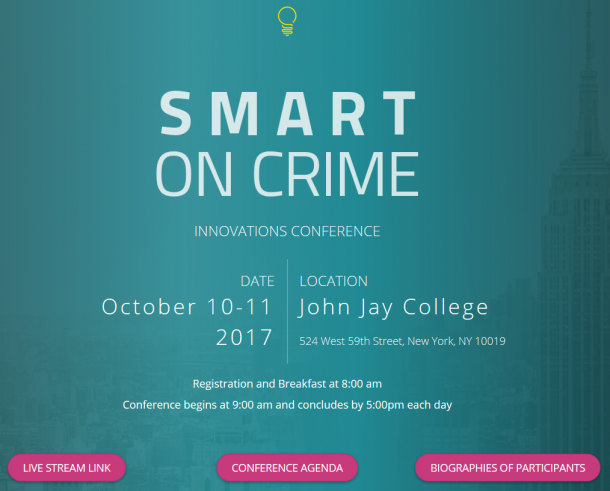

"Smart on Crime" Innovations Conference at John Jay College
(New York, NY, October 10-11, 2017)

Plenary Presentation: Greyston Bakery and Open Hiring
Jonathan J. Halperin gives Plenary Presentation at PRME Regional Meeting Agenda
College of Business and Economics, University of Guelph
(Guelph, Ontario October 19, 2017)

Business Doing Good--Jonathan Halperin "Open Hiring at Greyston Bakery and Beyond"
Conference Call sponsored by Good Cities
(October 19, 2017)

The Impact of Diversity, Inclusion & Equity in the Workplace
Jonathan J. Halperin joins a panel to offer insights on what being an inclusive company means, why it matters and what you can do to bring diversity to your organization.
(Washington, DC, May 15, 2017)
Selected Articles and Interviews
Rod Arnold hosts Jonathan Halperin, Head of External Affairs for Greyston. Greyston has been changing lives for 35 years through radical inclusion. A pioneering social enterprise, Greyston practices Open Hiring™ – providing jobs to individuals who face barriers to employment – in its world-class bakery and supports its employees and community members with a range of community programs. (December 23, 2017)


Capitol Pressroom, WCNY, New York, NY
Jonathan J. Halperin
(August, 1, 2017)
Once convicted criminals served their time in prison, another kind of sentence starts when many can’t find work after their sentence. Governor Cuomo’s Work for Success Employer Pledge encourages employers to hire those once considered unhireable. According to the administration, “moving these individuals into the workforce helps keep New Yorkers safe.” If the Greyston bakery in Yonkers is any indication, the program works. Greyston provides all the brownies for the ice cream made by Ben & Jerry’s. They have employed something called “Open Hiring” for the last 30 years. Jonathan J. Halperin, the head of External Affairs at Greyston shared the story.

Greyston Social Enterprise--Using Inclusion to Generate Profits and Social Justice
The Successful and Achievable Open Hiring Model
Today is the day we each need to decide: Do we want a society that is more inclusive or more exclusive?
That is the question asked and answered by this small bakery with a great, big mission.
April 25, 2017, BtheChange
(Mike Brady, Chief Executive Officer & Jonathan J. Halperin, Head of External Affairs)

The Sustainability Trajectory
(Jonathan J. Halperin, May 13, 2014)
Transitioning to expanded role as “engine for change” in sustainability, environment, and energy funding,
The Cynthia & George Mitchell Foundation invites external thought leaders to blog on their website.
Selected Media Coverage

Ben & Jerry's Supplier Greyston Bakery is Earning Brownie Points for Their Open-Hiring Policy
The Yonkers business plans to export its open-hiring practice across the US.
'Open Hiring has bottom line benefits'
Jonathan Halperin in Westchester Magazine, October 2017

How Hiring the Formerly Incarcerated Helps Rebuild Lives--and CommunitiesThe Crime Report, October 11, 2017

This New York Bakery Thrives by Hiring Anyone Who Wants to Work, No Questions Asked.
Jonathan J. Halperin quoted in Entrepreneur (August 18, 2017)

Brownie-Makers Wanted, No Application Needed
Urging leaders to take risks and think big at Weatherhead School
Jonathan J. Halperin quoted in beyond (June 21, 2017)
Ben & Jerry’s Supplier Greyston Bakery is Earning Brownie Points for Their Open-Hiring Policy
From decadent cheesecakes and creamy cannoli to rich almond tortes and buttery....
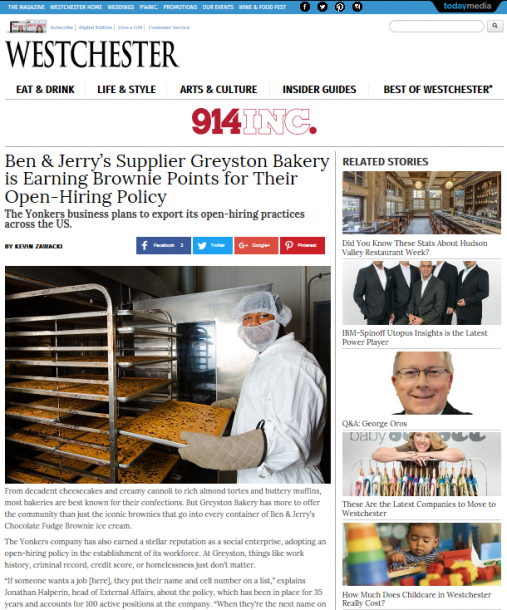
Westchester Magazine, October 2017
(Full text below.)
The Yonkers business plans to export its open-hiring practices across the US.
From decadent cheesecakes and creamy cannoli to rich almond tortes and buttery muffins, most bakeries are best known for their confections. But Greyston Bakery has more to offer the community than just the iconic brownies that go into every container of Ben & Jerry’s Chocolate Fudge Brownie ice cream.
The Yonkers company has also earned a stellar reputation as a social enterprise, adopting an open-hiring policy in the establishment of its workforce. At Greyston, things like work history, criminal record, credit score, or homelessness just don’t matter.
“If someone wants a job [here], they put their name and cell number on a list,” explains Jonathan Halperin, head of External Affairs, about the policy, which has been in place for 35 years and accounts for 100 active positions at the company. “When they’re the next name on the list, they have a job. We hire people without asking any questions.”
But don’t think for a moment that Greyston’s sense of benevolence comes at the expense of either quality or good business. Open hiring has bottom-line benefits: “It drives brand value,” Halperin says, lowers onboarding costs, and leads to higher-than-average retention rates.
Now, Greyston is looking to export their open-hiring model nationwide. “We can’t change the world at the pace we want, even by quadrupling brownie production,” Halperin explains.
So, in 2018, the Greyston team is launching The Center for Open Hiring at Greyston in Yonkers, which will provide consulting, research, education, and toolkits to other companies. “[It’s] designed to refine, promote, and share open hiring with businesses across the country,” Halperin says, adding that the best-suited companies are “those with entry-level manual-labor jobs where skills can be reasonably, quickly acquired.”
He also cautions that interested companies must be patient and open-minded. “Change can be unsettling,” Halperin says. “Because it is a new idea for many, [open hiring] requires commitment and persistence.”
Marsha Gordon, president and CEO of the Business Council of Westchester, says she’s not aware of any other organizations in Westchester practicing open hiring. Still, she’s intrigued. “We do see a lot of interest in exploring new ways to access talent, especially in today’s economy, which is facing a labor shortage,” Gordon notes.
At the end of the day, says Halperin, “People increasingly want to work at a place that is accomplishing something other than making a product.”
By Kevin Zawacki
"Bottom line, fair chance hiring is about the dignity of work."
Innovation in talent management and how that can drive social inclusion....

