
Insights — Blogs and Vlogs
Come gather ‘round people…
Come writers and critics…
Come senators, congressman…
Come mothers and fathers…
For the times they are a-changin’
Because Dylan was right, the topics our blogs and vlogs cover a lot of territory. They are diverse by design.

Icons Die Hard
“Fresh as the month of May” is how Philip Morris introduced the iconic Marlboro Man….
“Fresh as the month of May” is how Philip Morris introduced the iconic Marlboro Man in 1955, based on a photograph of a real cowboy from Life Magazine. The actor who originally portrayed the Marlboro Man died from emphysema in 1987. As the debate over the health impact of cigarettes began in earnest in the early 1990s, the intended association between smoking and healthy individuals living close to the land and enjoying glorious sunsets ran off the rails.

I thought of this while reading about the sharp 3rd quarter decline in earnings at both Coca Cola and McDonalds – two other global icons. According to the annual Interbrand survey, Coke’s scripted red lettering and McDonald’s golden arches rank as the 3rd and 7th most recognizable brands in the world.
As such, they are both just shy of the “Mom and apple pie” pantheon of sacrosanct American untouchables. Coca Cola spends almost $3billion annually to secure that place; McDonald’s spends about $1billion per year. (For context, $1billion is about $2.7million every day or $114,000/hour). Nonetheless, as AdWeek tells it, “…McDonald's reported a 3.3 percent quarterly profit decline, marking its worst performance in years, while Coke's profit dropped 14 percent with a continuing decline in North American sales during the same period.”
A McDonald’s “quarter pounder with cheese and bacon” contains the same amount of sugar (12g) as half of a Hershey’s chocolate bar (24g). A 12oz can of Coke serves up a whopping 39g of sugar. And consumption of added sugars, for which there is no Recommended Dietary Allowance (RDA), is increasingly clearly associated with rising rates of Type II Diabetes, Fatty Liver Disease and Metabolic Syndrome. It is also increasingly understood to be addictive and at the levels at which we are encouraged to consume it is potentially toxic as well.

Among the trip-wires that ultimately led to the downfall of the global tobacco giants (at least in the developed world) two stand out as ominous warnings for the beverage and sweetened foods sectors. First, it emerged that the companies had--but hid--the word’s best research on nicotine addiction and were ‘spiking’ their products to make them even more addictive. Second, it was not just that people were getting sick and dying from smoking cigarettes, but that they were using tobacco products in exactly the manner intended by manufacturers.
Soon there was no place for the executives to hide.

I don’t think Muhtar Kent, Coca Cola CEO, or Indra Nooyi, his counterpart at PepsiCo, are trying to kill people. I think they want to find a way out. I think they know they are in trouble. I think they want to preserve their branded icons. I don’t think they know how to satisfy the voracious appetite of mainstream investors for ever rising profits while also making substantial and healthy changes to their product mix. They need help to really innovate not just delay, deflect and distract. The innovation needs to be systemic to address the underlying problem; the business model that has returned enormous short-term profits to shareholders is over the long-term causing a public health disaster. Tweaking the amounts of sugar and tinkering with the product mix won’t cut it.
I thus had to shake my head in dismay when reading that in response to declining sales, still according to AdWeek, “[Coca Cola’s] recent acquisition of Monster Beverage Corp. underscores a strategy to diversify into the market of highly caffeinated drinks for youth.”
Refreshing as the month of May.
Are Borders History?
From earthquakes and mudslides in Chile, Japan and California; from droughts….
From earthquakes and mudslides in Chile, Japan and California; from droughts across America’s fruit and vegetable heartland; to flooding in Pakistan and creeping lava in Hawaii as well as a smoking volcano in Iceland; from killings in Ferguson, Missouri, to the Russian invasion of Ukraine; from the collapse of the state in Libya and the rise of the Islamic State across the Middle East; from Gaza to the Golan Heights one could be forgiven for feeling that things are coming unstuck.
Borders certainly are not the sacrosanct demarcation lines they once were – whether in Europe, Africa, or the Middle East. The Ebola virus crisscrosses borders largely unchecked from Guinea to Sierra Leone, from Liberia to Senegal and Nigeria. The traditional models of ensuring border security, public health, economic stability, and food distribution are under immense stress.
While NATO leaders plan for deployment in the future of a rapid deployment force to protect Eastern Europe, Russian boots on the ground have made a mockery of the border with Ukraine. Claiming a common cultural and linguistic identify with the eastern region of Ukraine that trumps international borders, laws, and principles, Russian leaders have “torn up the international rulebook…” according to NATO Deputy Secretary General Ambassador Alexander Vershbow. And Russia, “one of the most powerful nuclear nations,” as its current autocrat has thought necessary to remind everyone, becomes ever more mired in its own special form of historical dementia. Ever afraid of being encircled by enemies and cut-off from the world, Russia again has used brute force to enlarge its borders, creating a buffer zone of discontent people – thus guaranteeing that its greatest fears will come to pass. Unable to manage itself in the present, Russia calls upon its history and thus condemns itself to a future of endless struggle and strife.
The old story, about Brezhnev’s recurring nightmares still resonates. As Russians would tell it, Brezhnev awakes with a start, sits upright in bed, sweating, as he looks into Red Square and imagines a Pole eating Matzo ball soup – with chopsticks. Putin, perhaps, dreams instead of “New Russia,” Novorossiya, but his thinking is as old as Mother Russia herself. His mental map is from the age of Kievan Rus’ and Prince Oleg in the 9th century.
In other ancient lands, the new “Islamic State” has emerged as if from the ashes of death and destruction in Syria and the fragmentation of Iraq. While its brutality is positively medieval, its grasp of social media is very 21st century. And like Russia’s Putin, the “Islamic State” seeks to legitimize brutality with the patina of history – in this case the 7th century origins of a caliph as “the commander of the believers.”
In Russia, history has always been malleable. I was in Moscow when high school history exams were cancelled. After a spasm of truth-telling during the brief period of openness known as “Glasnost” it was clear that the answers provided in the history books that were used all year in schools were wrong – and there was thus no way to grade the exams.
Yet this sweep of human history, over thousands of years from caliphs and princes to social media and satellites, is but the blink of an eye against the slow tectonic rumblings of earthquakes and volcanoes. Whether continents or borders, customer relationships or supply chains, little is as fixed as we might like to think. Things change, always. Good news for cartographers -- and people and businesses leaning into unknown futures, respecting, but not trapped by history.
Reflections on Sugar
The thoughts below capture some aspects of my personal dilemma with sugar….
The thoughts below capture some aspects of my personal dilemma with sugar. Professionally, I also work with clients that manufacture products containing large quantities of sugar – while also working with foundations and nonprofits committed to helping Americans reduce sugar consumption. The conundrum is real; while no one wants to become sick or make anyone else sick, we live and work today within a tangled system of business decision-making and advertising, personal choices, and public consequences. Another blog, The Sustainability Trajectory, explores the challenges and opportunities over time as that system evolves – either predictably or in very disruptive ways.
I really like sugar.
I know too much sugar is bad for me.
The more I have the more I want.
I used to think honey was better than sugar.
I expect to find sugar in my Hershey Bar.
I did not know that one cup of condensed Campbell’s Tomato Soup also has 24 grams of sugar.

I really like both those companies.
I thought fresh, organic, natural juices were good for me.
I realize now that sugars removed from the fibers that bind them into fruits are metabolized differently.
I am sometimes bewildered when I shop.
Is a smoothie, with fiber, better than juice?
The body metabolizes high fructose corn syrup differently from other sugars, but I am not sure I understand exactly how.
One calorie is not the same as every other calorie.
According to the CDC, diabetes can be prevented through “healthy food choices”; afflicts 28 million Americans; was the 7th most common cause of death in 2007; and cost us more than $174 billion that year in direct and indirect costs.
$174 billion is more than thirteen times the total GDP of Iceland.
Americans are heavier than ever before, myself included.
But people who are thin can also be very sick with metabolic syndrome.
FedUp, the new movie, is very sobering.
According to the Harvard School of Public Health, the average American eats 22 teaspoons or 88grams of added sugar every day – not quite 4 Hershey bars.
The FedUp challenge to not eat sugar is hard.
Because there is no nutritional value to added sugars, food labels don’t share an RDA – which might help us understand more about what we are eating and drinking, and what it is doing to us.
80% of the 600,000 food products in the US contain sugar.
Coca-advertising budget in 2014 will be more than $4 billion.
Investors called for PepsiCo CEO Indra Nooyi to resign after she announced plans to focus advertising on nutritious products.
Dr. Robert Lustig’s you tube video on the dangers of sugar, The Bitter Truth,has over 4,600,000 views.
I am helping him build the Institute for Responsible Nutrition.
I really like sugar.
I know too much sugar is bad for me.
Have a nice day.
Truth and Power
Speaking truth to power rarely happens. But with four members of the SNAP….
Speaking truth to power rarely happens. But with four members of the SNAP Alumni network in the halls of Congress last week it did. I’ve blogged about that before (see Dispatches: Real Experts on Hunger and On Hunger and Respect in America) but am moved to write again based on today’s New York Times editorial ("No Time to Cut Food Stamps") urging Congress not to cut the meager, short-term assistance the government provides people without the means to buy food for themselves and their families.
As part of our work with Participant Media and the campaign for A Place at The Table, we invited four members of the SNAP Alumni Network to join us in Congressional meetings and in screening the movie. Whenever Leslie Nichols, Jennifer Tracy, Trish Henley, Nikki Johnson-Huston, or Okiima Pickett spoke members of Congress were riveted. Texting ended, nodding heads went upright, slumped backs straightened. It was quite a thing to watch.
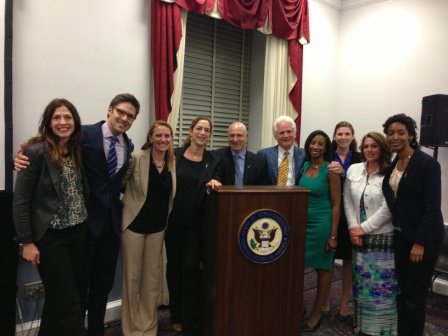
SNAP Alumni on Capitol Hill with Directors Lori Silverbush and Kristi Jacobson, Executive Producer Tom Colicchio, Jonathan J Halperin, Alden Stoner from Participant Media and colleagues.
As I said when introducing each of them, courage and leadership is what they embody. Many people have taken the food-stamp challenge and have tried to live for a few days on what food stamps provide. But imagine not only doing that for weeks and months but then becoming a successful tax attorney (like Nikki Johnson-Huston) or a nonprofit executive (like Jennifer Tracy), a college Professor (Trish Henley), a schoolteacher (Leslie Nichols), or an systems security architect (Okiima Pickett) – and then speaking before Congress about that experience? That is truth speaking to power.

SNAP Alumni (interactive mosaic on A Place at the Table website)
The Sustainability Trajectory
Transitioning to an expanded role as “engine for change” in sustainability….
The Sustainability Trajectory
Transitioning to expanded role as “engine for change” in sustainability, environment, and energy funding, The Cynthia & George Mitchell Foundation invites external thought leaders to blog.

In 2012, a little bakery just north of New York City became the first business licensed in New York State as a Benefit Corporation.
Thus Greyston Bakery joined companies like Patagonia, Etsy, and Ben & Jerry’s in advancing a fundamentally new model for business that focuses as much on a declared social mission as on its business purpose. The advent of benefit corporations signal the beginning of a profound structural shift in the business of doing business—the first of four disruptive shifts discussed in this essay.
Far from being set and fixed for all time, the core structure of business is fluid and evolving.
In 1811, New York State enacted the first law in the United States providing for the formation of limited liability corporations. Since then we have enjoyed incredible benefits from a period of industrial production unsurpassed in human history. And while it may be seem inconceivable that this period could be winding down, it would be equally foolish to bet that it will continue forever. With this unparalleled productivity has come consumption on a scale that cannot be sustained, in part because the wealth produced in this 200-year stretch of human history has also generated inequality on a scale that is mind-boggling. The 85 richest individuals on the planet have amassed wealth equal to that of the 3.5 billion poorest people in the world.
Baking brownies in Yonkers is not going to close that gap. But as a benefit corporation, Greyston is not just, or even primarily, in business to bake brownies. Greyston does not hire people to bake brownies so much as it makes brownies in order to hire people. Greyston’s social mission is open hiring whereby it hires people on a first-come, first-served basis without asking for references or doing any type of background check.
They are in the business of hiring the structurally unemployable (those who have been in jail, on drugs, or homeless). Other benefit corporations have declared other social missions such as conservation for Patagonia or “re-imagining commerce” for Etsy. While there are about one thousand benefit corporations today, there were no limited liability corporations in the United States until 1811 (although business trusts and partnerships existed).
Benefit corporations are of course not the only mechanism through which a business can demonstrate its commitment to socially responsibly behavior. Corporate sustainability reports and corporate foundations often expound on the “good works” being done in the communities in which they operate. But these efforts are often isolated from business operations, relatively inconsequential to the business financially, and not factors in internal business decision-making.
The benefit corporation model pulls responsibility for the social and environmental elements of the triple-bottom line out of philanthropic giving and sets it squarely in the executive suite—embedding those considerations in the core product or service of the business.
Benefit corporations thus fundamentally shift the balance of business priorities. Shareholders become just one powerful group among multiple stakeholders—practically not just rhetorically. The need to run a profitable business remains critical; no money, no mission. But the reasons for running the business are significantly expanded, as is the timeline against which success is measured.
A second disruptive structural change on the sustainability horizon is a shift in the basis for executive compensation. While the data remains somewhat opaque around this issue, what is unmistakably clear is that many more Chief Executive Officers sign eloquent and heartfelt letters to introduce sustainability reports every year. But they rarely actually put their compensation on the line to achieve sustainability goals.
According to a new CERES report, a scant 3% of 613 large publicly traded American companies link executive compensation to anything more than mere regulatory compliance on sustainability related matters.
Sustainability reports have been central to disclosure and transparency; they have given investors and advocates a point of access and leverage; and they have enabled companies to benchmark against best practices. But they have not, generally, worked their way onto the C-suite decision-making dashboard. Sustainability data, painstakingly collected and analyzed, rarely forms the basis for core business decisions. That would change—and fast—if leadership compensation was as closely linked to sustainability metrics (from water and GHG emissions, to community investments and labor practices) as it is to ‘making the numbers.’
As much as we need to redefine leadership, and the compensation that goes with it, so too does the notion of “supply chain” need to be reconceived. And this too will be highly disruptive for leaders and investors who cling to an outdated and narrowly circumscribed definition of the role of business being exclusively about producing products to generate near-term profits for its owners.
Once upon a time not so very long ago, what happened inside distant plants or on fields in far away lands, managed by layers of absentee investors, employing isolated workers with limited voice and even less political clout, seemed safe to ignore. But over a ten-year period, that changed dramatically.
In 1984, chemicals leaking from a Union Carbide plant in India killed thousands, and Bhopal became a household name. Five years later the Exxon Valdez ran aground and poured crude oil into Prince William Sound, tarring Exxon with the stain of corporate irresponsibility that has been impossible to remove. And for years in the 1990s, Nike was dogged by claims, and then acknowledged, that children in impoverished nations were making its shoes.
In a little anticipated shift, global businesses were forced to expand their horizons and exercise responsibility not just inside factory walls but also up and down global supply chains. But those “chains” were, and to a great extent still are, conceived of as circumscribed bands of direct inputs that flow vertically upward into products of ever increasing value.
We are now entering an age in which that band is bulging and the myriad horizontal connections at each point along the chain have also become of concern to global manufacturers. The flow of supplies is a web, an ecosystem—not a chain. The plant that makes cotton t-shirts relies on cotton grown in fields, picked by workers, sustained by nutrients and water and moved to market in myriad ways. And while a textile manufacturer may not perceive itself as being in the water business, that mindset exposes the business and its investors to immense risk if the price for cotton skyrockets due to competing demands among farmers, bottlers, other companies and citizens for access to limited water resources.
Managing the interconnected web of resources for multiple users is going to push buyers and procurement teams and their senior leadership to develop whole new skill sets and layered systems to ensure access to resources. Brute market power and dominance may temporarily forestall the day of reckoning for some corporations that cling to the notion of limited supply chain responsibility. But those that grasp the web-like quality of modern supply will likely prove more resilient and capable in the face of future challenges.
And finally, perhaps it is not really sustainability that holds the key to future prosperity across the triple-bottom line. Despite all the reporting, the deeply dedicated sustainability teams, and the efforts to build systems and software and better metrics, perhaps at the end of the day what we really should focus on is neither financial performance, nor integrated reporting, nor even the growth of the benefit corporation. Perhaps we are heading into an era in which we will begin to package these indicators into something vastly more than the sum of the parts to assess the overall health of a corporation. Whether organizational or personal, it is health that really tells us how we are doing, what we should be doing more of or less of, and how we stack up relative to others of similar type and size.
It is not a simple metric, but corporate health or wellness may be the elephant whose individual parts we have been poking at for some time without being able to fully see it for what it truly is—the underlying measure of a company’s capacity to generate value over time.
Sustainable Living or Survival of the Fittest?
This year’s CERES conference in Boston was provocative and challenging….
This year’s CERES conference in Boston was provocative and challenging -- as it should be in celebration of 25 years of creative, innovative, and collaborative advocacy to bring greater openness and accountability to corporate behavior. And it is behavior, of course, that needs to change; openness and accountability are only the tools of the trade in modifying corporate practices.
Paul Gilding, perhaps the speaker who made the audience most usefully uncomfortable, painted two competing visions of the future. One, the Unilever Sustainable Living Plan, champions collaboration, aggressive sustainable agriculture practices, and a fundamental reorientation toward attempting to do more with less, continuing to grow and expand but with an increasingly limited footprint. Gilding also celebrated the clarity with which ExxonMobil has now articulated a different vision of a global economy driven by aggressive use of fossil fuels, where lack of climate stability is seen as a cost of business as usual, and within which ExxonMobil’s rightly vaunted discipline in execution is seen as its competitive trump card in a go-it-alone world.
While perhaps overstated a bit, I concur with his fundamental view, having served as a consultant to both Unilever and ExxonMobil -- although the engagement with ExxonMobil was abruptly ‘paused’ due to differing visions of what constitutes responsible behavior around climate change. Unless the most esteemed international scientists have it all wrong, the two competing visions of the world are pretty stark. If we push past an overall global increase of temperature beyond 2°C, the natural ecosystems that have evolved into a relatively stable and hospitable climate for our species are going to shift dramatically. And if the work commissioned by the US Department of Defense some years ago from the Global Business Network (run by Peter Schwartz, long-time scenario planning chief at Shell) is right, then we may be looking at abrupt rather than gradual changes in the global climate.
As with much change, wealth provides insulation. Resources can be mobilized to plan, defend, and identify alternatives when threats present themselves. But walled castles, cities, communities, and nations have a way of failing over time. While perhaps splendid in their isolation during their halcyon days, they also are brittle. Sea walls may be the Maginot line of the 21st century.
But there is a point at which the dynamic of “growing concentration of wealth and increased dispersal of political power” sends tremors through both markets and governments. And this was articulated well at CERES by Mary O’Malley from Prudential, an insurance company that knows a thing or two about risk.
While no one at the CERES conference was counseling the need to abandon ship, many stressed that business as usual is no longer tenable. From Roderick Morris at Opower to Rob Olson, Chief Financial Officer at IKEA US, the resounding message was to get ready for rough sailing into a vast sea of change. And those outfitted properly for the voyage stand to reap vast rewards. As Morris rightly noted, it is an invitation to innovate when the market presents a situation where “energy and water are cheap and saving them is boring.”
From Olson at IKEA, we were reminded that preparing for this new era requires flexibility and leadership to change traditional thinking. For decades companies have forsworn adjusting hurdle rate (return on investment targets) to accommodate viable sustainability projects that will bring long term value to stockholders, but by definition take longer to mature. IKEA has wisely adjusted hurdle rates outward from 8-10 years or in some cases to as far out as 25 years for critical sustainability investments.
Twenty-five years is 100 quarterly statements and 100 calls with Wall Street analysts. Few business leaders here today will be on those calls – and we generally lack bandwidth, systems, governance, and management capacity to manage out twenty-five years. But who among our business leaders today is planning for their companies to be out of business in twenty-five years? To survive, business leaders need to stop waiting for analysts to ask questions on those quarterly calls about the painstakingly compiled sustainability reports – and instead start actively presenting sustainability as core to the long-term generation of value for investors.
Leaders hesitant to make the case for sustainability as a core business mission and companies with a culture of complacency about their market position would do well to remember the fate of iconic brands that also “missed the memo” on change: Blockbuster Video, Borders, Polaroid. Who’s next?
Dismayed by one IPCC report after another (each showing with ever increasing certainty that the global climate is become more and more unstable), reading a steady flow of nerve-racking news from Ukraine, wincing at the stories of horrific abuse in Nigeria and Sudan, and still hoping for a more robust economic recovery -- it is useful to reflect on the powerful examples where hope and hard-work have combined to overcame seemingly overwhelming odds. Mary Robinson, the former President of Ireland and no longer the youngest member of the The Elders organized by Nelson Mandela, reminded us all of how Archbishop Desmond Tutu response to a question from a journalists about how he remains an optimist in the face of crushing hardship: “I’m not an optimist. I am a prisoner of hope.”
Risks over Time
Since participating recently in the UN Investor Summit on Climate Risk….
Since participating recently in the UN Investor Summit on Climate Risk, and in preparing for the Sustainable Land & Water Program Expert Workshop in Amsterdam on Friday, I’ve been thinking more about risk as fundamental conceptual framework for making meaningful comparisons and connections. Risk is ineluctably comparative; some actions and decisions carry more risk than others. There is physical risk for a bobsledder, financial risk for a chief financial officer. What seems risky to me, may seem not at all so to you.

And risk speaks to how we value what we don’t know. If we knew everything – past, present and future we would have certainty, i.e. the absence of risk. While leadership and intelligence each have many definitions, both require the capacity to choose wisely in the face of uncertainty.
Equity and fairness are also embedded in and sometimes obscured by how we present risk. As an agricultural buyer I reduce the risk of supply disruption by contracting with multiple suppliers; and as a farmer I can reduce my risk of a bad harvest by diversifying my crops. But when I farm higher up on a steeper slope to expand my acreage, I may create new and unforeseen risks for the downstream fishing village that may be wiped out by the silt washing off my hillside. Risk is often location specific—my hill, your river—and also very time sensitive.
And when we draw down nature’s capital stocks today, whether of rare-earth metals or carbon absorbing forests, we shift risks out into the future. As discussed at the UN Investor Summit on Climate Risk, stranded assets thus represent an interesting test-case of how we define present versus future risks. “Known reserves” in the oil and gas sector have traditionally been valued as assets and carried on the books of global companies on the presumption that the assets will be productively used at some future moment.
But there is a wrinkle in this thinking – a serious wrinkle – as documented by the work of CERES and its insurance and business partners. The risks of actually combusting all fossil fuel reserves across the planet are so high that upon serious consideration, no one really believes we could survive if we used 100% of these reserves. So, if some number less than 100% is actually usable, then some of those reserves are ‘stranded assets’ with quite limited value if they are never going to be used. How overvalued are the oil majors: one or two or ten percent? And that makes for a very different discussion about social, business, and financial risks in the oil and gas sectors.
Looking ahead to the meetings in Amsterdam, and immersed at the moment as well in a World Bank project on agricultural risk, looking at landscape- rather than farm-level productivity may (like stranded assets) unsettle decades of thinking in agriculture. The unceasing call for yield and productivity improvements may well have taken us down a path to short-term success while pushing extraordinary risks out into the future as we have undermined the productive health of landscape ecosystems around the world.
From a landscape-level perspective, a particular farm is only as healthy and productive over time as the landscape around it that provides for, among other things, soil nutrition. While we can postpone the day of reckoning for decades, a farm in the midst of a destroyed and denuded landscape is hardly a farm at all – even if it still has some productivity left in its tired soils. It too risks becoming stranded, as the assets around it that once breathed life into it become barren and infertile.

Like life itself risks rise and fall in response to both planned events and unintended consequences. That we have the capacity to manage risks wisely and with deep respect to how risks change over time is clear. Whether we have the will to do so is the greater challenge.
2014 A Happy New Year
I am comforted by the awareness that changes we dismiss today as….
I am comforted by the awareness that changes we dismiss today as inconceivable are often viewed by historians as having been inevitable.
A Happy New Year might thus include news of the following momentous changes.
Following in the reconciliation footsteps of Nelson Mandela, President Salva Kiir of South Sudan and his former Vice President Riek Machar reach an accord to prevent this newest of nations from sliding into tribal anarchy.
Noting that even Al Queda can apologize and take responsibility for being in the wrong for allowing one of its own to attack a hospital in Sanna, Yemen, George W. Bush and Dick Cheney apologize to the American people, admitting that they were in fact grievously wrong about the existence of weapons of mass destruction in Iraq.
In a surprise announcement in Davos, CEOs Paul Pohlman (Unilever), Lloyd Blankfein (Goldman Sachs), Larry Page (Google), Mark Parker (Nike), Sam Walsh (Rio Tinto) and Norbert Reithofer (BMW) confirm rumors that beginning in 2016 they will base executive pay, including their own, not only on financial performance but also on sustainability achievements.
Following copy-cat revelations in China and Brazil from whistle-blowers like Edward Snowden, the permanent members of the UN Security Council announce that they have begun implementation of a global intelligence gathering consortium to combat terrorism; and in a stunning move Republican leadership in the Senate vows to push for quick passage in the U.S.
Finding common purpose in sustaining the long-term vibrancy of American democracy, Bill Koch, Bill Gates, George Soros, and Robert Reich (Board Chair of Common Cause) call for an end to all private funding for U.S. political campaigns.
Recognizing the immensity of the self-inflicted economic damage that ripples through the economy from hunger and poverty, Mitch McConnell, Harry Reid, John Boehner and Nancy Pelosi announce a determined bi-partisan effort to raise the minimum wage to $15/hour.
In an equally unexpected outpouring of bipartisan concern for the future of the country, House and Senate leaders pass of a carefully constructed carbon tax that is progressive, avoids stranding assets, and creates a truly level playing field; the US Chamber of Commerce and ExxonMobil push for passage, arguing that a stable climate is essential for long-term business investment.
In response to questions posed to President Putin at the Sochi Olympics, he admits knowing next to nothing about the other twenty thousand prisoners he released along with Mikhail Khodorkovsky and the members of Pussy Riot.
In a continued effort to introduce competition in the energy sector, House Energy Committee Chair Fred Upton (R-MI) and his fellow Michigan Representative, Democrat, John Dingell, propose legislation to repeal the Price-Anderson act, which indemnifies the nuclear power industry for any losses exceeding $12.6 billion.
And in a stunning announcement cheered by consumers around the world Samsung, Apple, Google and Microsoft agreed to provide their unique mobile applications and services via a common platform and with fully compatible plugs, cords, and charging devices.
Hope springs eternal. Happy New Year!
"What is Hunger?" and "Hunger In Our Backyard"
Video for the first two morning panels of The James Beard Foundation….
Video for the first two morning panels of The James Beard Foundation 2013 Food Conference (The Paradox of Appetite: Hungering for Change, Oct. 21-22) appears below. For the entire two-day's proceedings, visit the James Beard Foundation's 2013 Food Conference video channel.
Panel: "Hunger In Our Backyard"
Mariana Chilton, Director, The Center for Hunger-Free Communities
Nikki Johnson-Huston, Esq., Law Office of Nikki Johnson-Huston
Rep. Jim McGovern, Congressman, Representing the 2nd District of Massachusetts
Jonathan Halperin, Founder, Designing Sustainability
Big Data Might Live Next Door
With more than 47,000,000 Americans only able to buy their next meal….
With more than 47,000,000 Americans only able to buy their next meal because they are on SNAP, formerly Food Stamps, one wonders where these people live. 47 million sure sounds like a big number. But where are they?
Try this thought experiment. If we wanted to move everyone on SNAP into concentrated hunger zones we would need to empty the fifty largest cities in America in order to make room for 47,000,000 people. Ponder that for a moment. All of New York, Los Angeles, Chicago, Dallas, Miami – and Virginia Beach, Virginia, and Arlington, Texas. If you can imagine everyone in all of the cities listed below as hungry and on SNAP, then you are beginning to grasp the scale of the problem.
So, while 47,000,000 is a huge number, the people that make up that number must be all around us: down the block, around the corner, across the road, on the bus, in the elevator. Maybe we work with someone on SNAP. Maybe we have a friend who has not told us they are struggling. Maybe that kid in the park?
Where is hunger in your world?
Facts -- Not What They Used to Be
The story of hunger in America is quite instructive, and as the radical right….
The story of hunger in America is quite instructive, and as the radical right plays financial chicken with the federal budget and the good faith and credit of the United States, 47,000,000 citizens wonder where they will find their next meal. In an America where compassion remains a core value, this is only possible because people have differing visions of reality.
For those in denial of the problem it is impossible to accept that Mitt Romney’s moochers and cheats deserve anything at all, much less a government hand-out. They are an undeserving and unmotivated underclass, so unworthy as to be dispensable. They are unseen and unwanted, a blemish on America the Beautiful. They are the proverbial “other,” perceived as so unlike “us” that they can be subjected to denigration, harassment, and denied basic human dignity and respect.
And facts, the stock and trade of those who would have us address this problem, rarely penetrate this emotional veil. The more facts disseminated the more the veil closes, the more overwhelmed people become, the more people close ranks and invest more deeply in self-reinforcing stereotypes about “us” and “them.”
Story-telling and personal inspiration, however, can pierce this veil of denial. And for that reason I continue to feel privileged to be involved with A Place at the Table, the film that puts a new face on hunger in America. The sheer emotional power of the film shatters the ‘us/them’ dichotomy and speaks to a more basic sense of human empathy. Whether leading a discussion around the film earlier this year in Denver (below) or showing a clip from it next week at the James Beard Foundation Conference in NYC, I believe in the power of story telling to drive transformational social change.
It is one thing to deny this or that fact in an ocean of information. But it is quite another to look someone in the eye who has been without adequate food for months or weeks and challenge their experience. The words and images of SNAPAlumni are poignant and inspirational, personal and evocative.
They demand that we act to strengthen our communities and our nation by bringing an end to hunger in America. Let us get on with it, now. Where is hunger in your world?
What Does 48 Million Hungry People Look Like?
48 million Americans struggle with hunger….
48 million Americans struggle with hunger. 48 million names. 48 million stories. How have we let this happen? America's better than this.
Neighborhoods
As summer slowly releases its muggy grip on the nation’s capitol….
As summer slowly releases its muggy grip on the nation’s capitol, I had an opportunity to talk with the Israeli ambassador to the United State, Michael Oren. With the civil war in Syria propelled to front and center, he reminded us that “it’s the neighborhood we live in.”
And how much neighborhood – where we are - matters. Long before 9/11 I worked in the World Trade Center, as we reflect today on the murder of those who perished as the towers burned and collapsed. As bells toll today to evoke memory, so too for Jewish people all over the world was the Shofar sounded last week to usher in a new year that begins with a period both of reflection and commitment.
Fortunate children walk through neighborhoods excited about the new school year, nervous about new teachers, yet faces beaming with possibility. Yet other children, who comprise fully 47% of families on food stamps in the US, face challenges that can seem insurmountable. And in many places like Hama, Maalooula and Al-Qusayr whole neighborhoods have been obliterated.

Yet how can we be other than optimists, leaning forward, working to improve life, trying to bring hope and possibility to more and more children? My involvement with Mundo Verde, a start-up charter school in Washington, DC, reminds me of how much can be achieved when people work hard to create new, open, inclusive, and innovative communities. (For more on Mundo Verde, see Expeditionary Learning: A New Approach to Sustainability-Focused Education in the new issue of Sustainability.)
Perhaps Russia and America can eliminate chemical weapons in Syria? Perhaps the US Congress will expand rather than reduce SNAP benefits? Perhaps leaders will take heed of the forthcoming IPCC climate change report?
Perhaps what seemed inconceivable yesterday, will tomorrow appear to have been inevitable? After all, change is the only thing we can really say is guaranteed.
Real Experts on Hunger
In a rare series of events on Capitol Hill yesterday, and continuing today….
In a rare series of events on Capitol Hill yesterday, and continuing today, America’s real experts on hunger in America met with senior members of Congress and their staffs.
Five members of the SNAP Alumni network organized by Participant Media and The Marcus Foundation (with additional support from The Ford Foundation) in conjunction with the release of A Place at The Table, spoke to senior members of the House including Steny Hoyer (MD), Ted Deutch (FL), Jan Schakowsky (IL), John Conyors MI), Rosa DeLauro(CT), Bobby Scott (VA), and David Cicilene (RI).

Members of the Congressional Caucus on Poverty (right)
meeting with A Place at the Table Directors Lori Silverbush and Kristi Jacobson
along with Tom Colicchio and others (left)
Excerpts from the movie were shown both to individual members and staff and during an evening screening. As continues to be the case in commercial theatres nationwide, and in more than one hundred community screenings, the movie stops people in their tracks. And key to that storytelling so beautifully rendered by directors Lori Silverbush and Kristi Jacobson are the stories of real people struggling with not knowing how they will put food on their table.
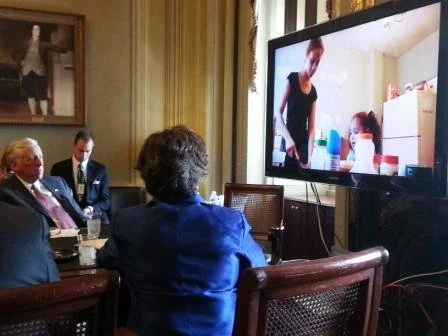
Steny Hoyer, House Minority Whip, watching A Place at The Table
One of those individuals from the movie, Leslie Nichols, a teacher in Collbran, CO, came with us to the Capitol and fought back tears while recalling her story of being on food stamps as a child and how she nonetheless fulfilled her dream of becoming a teacher. Equally powerful testimony was provided by:
Jennifer Tracy, Executive Director of San Diego Hunger Coalition
Okiima Pickett, Security Architect with IBM & DC Divas and Team USA, Running Back
Nikki Johnston-Huston, 2012 Eisenhower Fellow and Tax Attorney
Dr. Trish Henley, Professor of English Literature at University of Cincinnati
In facilitating the discussion that featured not only these dynamic and powerful women, but also Top Chef Tom Colicchio and Representative Jim McGovern, I urged members of Congress to honor the courage of the SNAP Alumni as they debate and mark-up the Farm Bill this week and next. Providing temporary, short-term and very modest support to Americans in need is not an expense of the US government; it is an investment in people who are the backbone of our nation. Learn more about the SNAP Alumni network at www.takepart.com/table.
Full disclosure: I am a trustee of The Marcus Foundation which has provided funding to Participant Media.
A Place at the Table - Trailer
Yes… But…
Rich and deep conversations are the hallmark of CERES conferences….
Rich and deep conversations are the hallmark of CERES conferences and this year in San Francisco was no exception, as CERES looks forward to its 25th anniversary in 2014. During the conference the newly released CERES report on fracking and water stress was covered in the New York Times. And General Motors signed the Climate Change declaration.
At the conference, Bill McKibben sounded yet another eloquent call for urgent action, warning the more than 500 participants that getting this done “over time” is no longer an option. On the global freshwater crisis, Peter Gleick from the Pacific Institute similarly observed that we have already passed the point of “peak water” and that unlike peak oil there are no substitutes for water.
Dan Hesse, CEO of Sprint, noted that measured along a very much shorter time-frame he has never been asked a question about sustainability on any of his quarterly earnings calls. At the other end of the spectrum Heidi Cullen, Chief Climatologist for Climate Central, reminded everyone that when the Dutch government vowed in the mid-20th century to protect its people from massive flooding, it opted not to prepare for a one in a hundred-year storm but rather adopted an 800-year time-horizon.
Although the redwood groves in Muir Woods, a mere 16 miles north of the conference site, are heirs to the tree-like ferns that appeared on earth 300 million years ago (the fossilized remains of which are today’s fossil fuels), who among us can think out anywhere close to 800 years?
But, on the other hand, who among us wants to predict when the companies we work for, or buy products from, will cease to exist? While no executive will admit to planning for the closure of his or her businesses, lack of longer-term thinking is essentially exactly that. If we are not implementing sustainability practices now -- managing resources such as water and soil health and biodiversity and atmospheric capacity for carbon absorption -- then we are failing in our fiduciary duties to preserve and generate value for stockholders and stakeholders.
Yes, but as much as we need to deepen the capacity of our species to think long-term we need to ‘scale’ urgently not ‘over-time.’ As David Blood from Generation Investment made very clear, longer-term business thinking about sustainability also yields near-term results: risk mitigation, cost reductions from greater environmental efficiencies, employee retention, and lower cost of capital.
But how do we scale, accelerating business change such that it is in synch with what science tells us are the outer limits of time and temperature before the fragile window closes that has allowed our species to develop over about 200,000 years – which is either a very long time for an earnings analyst or a mere blip in geologic time.
The answer often proposed, taking things to scale, may be right. But scale may not mean bigger. Scale might not mean building acres upon acres of solar panels far away from electricity users. Rather it might mean small solar clips we can attach to our cell phones. In America alone, with an estimated 328 million phones dispersed among a population of 314 million people this might not be such a small achievement. A different kind of scaling.
But could such a device be invented and marketed by a company if in its development it has the same RoI hurdle rates as all other corporate undertakings? Would investors and analysts on those quarterly earnings calls have the stomach for it? Seems like the Dutch did after the Great North Sea Flood of 1953. Was hurricane Sandy enough to galvanize Americans?
Buses and Sustainability
I have buses on my mind – lots and lots of school buses sitting in parking lots....
I have buses on my mind – lots and lots of school buses sitting in parking lots all over the world. In the United States about 480,000 yellow school buses take kids to and from school, and on fields trips. And are then parked.
What I have come to like about buses is that they are a form of sharing. Whether in public or private use, buses embody the notion of a shared need – a common route. They are thus aggregators, of commuters or students, or in innovative settings much more. But in aggregating, they also preserve an individuals particular need.
Verizon, for example, now uses buses to deploy technicians in New York City, in addition to individual trucks and vans. The buses are packed with equipment, some mobile and some fixed, and drop technical staff where they are needed to address customer problems and then pick them up when they are done. Saves a lot of time (looking for parking spaces, fuel, vehicle maintenance and so forth). In retrospect, seems like a no-brainer.
In the national capitol region around Washington, DC, another bus has been repurposed as a green market. Run by Arcadia Center for Sustainable Food & Agriculture, it also follows a set route but this repurposed bus collects fresh produce and meats from area farmers and delivers them to underserved neighborhoods. Customers can use government SNAP, WIC, and SFMNP funds to buy healthy, local, fresh food. Another no-brainer, in hindsight.

As I head to the CERES conference “Igniting Innovation, Scaling Sustainability”, I wonder how we can more effectively use such underutilized assets: school buses that spend more than half their useful lives parked, offices that are empty for as many hours as they are occupied, and school kitchens and lunch rooms deserted after students go home.
Enough Defining
Implementation, not definition, is the challenge for sustainability today....
Implementation, not definition, is the challenge for sustainability today. Despite much harrumphing and navel-gazing about what exactly sustainability means, the core is clearly understood. As we have explained it to young students at Mundo Verde, sustainability means taking only what you need now and saving the rest to share with others. One can quibble over that simplification, but at core it is correct. And around that core are many facets that both enable and challenge people grappling with how to ‘do’ sustainability.
As movingly captured last evening at the premiere of La Expedición at the Josephine Butler Center in Washington, DC, the Mundo Verde community works on three facets of sustainability, nurturing children to become future leaders. I facilitated the discussion afterwards with invited parents, education thought leaders, faculty, and community leaders.
The public premiere is Saturday, April 20 at 5:30pm at North Columbia Heights Green in the alley off 11th Street NW between Park Road & Lamont Street 6:30 pm-8:30pm (Facebook event page). This event is free and open to the public. (Special thanks to Meridian Hill Pictures and Washington Parks & People.) Questions? Contact: communications [at] mundoverdepcs.org

Mundo Verde is a bilingual school, ensuring that the leaders of tomorrow have skills to navigate and collaborate in a multicultural world. Second, students learn both in the classroom and even more fundamentally outside through carefully developed learning expeditions. And third, sustainability is both explicitly taught and modeled through the schools work with vendors. The outdoors thus becomes a classroom while the classroom becomes a teaching tool.
While the food provided by James-Beard Foundation award-winning chef Todd Gray and Ellen Kassoff, partners in Equinox, for the premiere of La Expedición provided a lovely backdrop to this event, agriculture and the global food system was the central focus of last week’s Sustainable Food Laboratory summit where I presented the results of research undertaken for Unilever. With Molly Jahn from the University of Wisconsin, I urged leaders from leading companies (PepsiCo, Coca-Cola, General Mills, Cargill and others) and NGOs (Oxfam, Eco-Agriculture Partners, Conservation International, BSR and others) to build on the current farm-level certification systems and embrace landscape-level monitoring.
And on the flip side, hunger too is part of the sustainability equation. How can we have a sustainable world with nearly 2 billion people malnourished – roughly a billion of them from hunger and the other half from obesity? A Place at the Table opened last month in thirty-two markets and the digital mosaic we created of successful Americans who were once on food stamps continues to draw people in to an expanding national conversation and policy debate on ending hunger in America.
Stay tuned for more news from Mundo Verde and A Place at The Table, as I am also en route shortly to the CERES conference in San Francisco – where the focus will surely be more on the doing than on the defining.
On Hunger and Respect in America
As Representative Jim McGovern said from the floor of the House....
As Representative Jim McGovern said from the floor of the House of Representatives a few days before president Obama’s State of the Union last evening, “Hunger is a political condition.” (Transcript)
50,000,000 Americans are not on SNAP (formerly food stamps) because of a lack of food in America. Nor do they suffer the indignities of this program – which often last a lifetime – as a means of defrauding the government of what is on average a meager $4 per day.
With the head of the state office that issues food stamps in Colorado in the audience, with representatives of the Governor’s office present, and with Representative Dominick Moreno at her side, Leslie Nichols spoke eloquently through tears as she recounted her experience growing-up with an empty refrigerator and wondering where she would find her next meal. A teacher in Collbran, CO, Leslie now delivers food to hungry families. Her poignant and powerful relationship with Rosie, a fifth grade student of hers, is movingly portrayed in A Place at the Table -- which opens in theatres nationwide on March 1.
I had the honor last evening in Denver to introduce the film and moderate a panel with Leslie, film director Kristi Jacobson, State Representative Dominick Moreno, and Kathy Underhill from Hunger Free Colorado. Threaded throughout this conversation last evening were issues of core American values: dignity, respect, community, and trust.
In every community in this nation, we have neighbors who are hungry. And this is not the kind of hunger we all experience for having missed a meal. This is a grindingly chronic hunger that goes on day after day after day. And yet the vast majority of people receiving federal support to purchase food receive this aid for ten months or less. They do not abuse the system; they are not moochers but people who have hit a tough stretch. The majority of this 50,000,000 are employed either part- or full-time. And one of out every four children in America today is on food stamps.
We have allowed the tragedy of hunger to exist in this country – it has become the new normal – by branding the hungry as somehow less worthy, less American, and deserving of less respect than other ‘real’ Americans. But this is about to change.
In a collaboration between Participant Media, The Marcus Foundation, The Ford Foundation and major national anti-hunger organizations, successful Americans who were once on food stamps or SNAP are speaking-out about the value of the program and the dignity of the hungry. Bill Ritter, the former Governor of Colorado has had the courage to tell his story. So has Moby, the renowned electronic musician. And TV film star Debi Mazar. And Patty Murray, the four-term Senator from Washington State.
The “political condition” of hunger as Representative McGovern so precisely described it, is changing. And while change can sometimes seem agonizingly slow, when it gains critical mass – like a wave – its power should not be underestimated. Imagine 50,000,000 hungry Americans rejecting the social stigma that has silenced them and finding their political voice. Stay tuned.
“Pandora’s Promise” – Can it Be Kept?
Robert Stone has produced a provocative and important new documentary....

Robert Stone has produced a provocative and important new documentary on nuclear power that was screened this week at the Sundance Film Festival. But as important as it is, Pandora’s Promise is a film that in its current configuration undermines itself.
Stone sets out to document how the dangers of our unstable climate have pushed him and a set of people featured in the film to revisit their long-held opposition to nuclear power and instead embrace fourth generation nuclear, or Integral Fast Reactor (IFR) technology. Fourth generation nuclear may indeed offer safety improvements over current operating nuclear reactors that are fundamental game changers. But the credibility of that notion is called into question by other aspects of this movie that is at once passionate and heartfelt and very unsatisfying.
The cast of characters chronicled throughout the movie are not only never identified in terms of who they are or what they do, but also engender little empathy or interest as they tell their stories. They are clearly sincere in their various professional assertions and descriptions but they lack depth. We learn almost nothing about them as people in the course of the movie; it is almost as if they are actors playing themselves rather than real people telling real stories.
And some of the assertions and scenes strain the limits of credulity. Michael Shellenberger, never identified beyond his description of himself as an environmental activist, voices what he claims is a common view -- that he was stunned to learn that background radiation exists naturally on earth and is not purely a human creation. Really? Perhaps he will say more about this during his scheduled appearance on The Colbert Report on Monday, January 28th.
And a few scenes also look like they might have been staged. Do scientists visiting the exclusion zone around Fukishima really collect radiation data wearing radiation suits with no head covering or breathing apparatus? Are they partially suited to make the point that suits aren’t really needed at all or conversely to show brave scientists doing what it takes to get important health data? Or is it just to add dramatic tension to the film?
But more important than these small items, the movie seems to cherry-pick and even distort data to about nuclear power, past and present, to make the case for its future. I posed a few questions about this. The movie claims, correctly, that Chernobyl claimed only 28 deaths due to Acute Radiation Syndrome and drums home the authenticity of this data point with a ponderous parade of acronyms over the highlighted line from the international report coordinated by WHO ("Chernobyl’s Legacy: Health, Environmental and Socio-Economic Impacts"). But there is no mention made – other than to skewer Helen Caldicott – of equally well-documented facts such as the following from a WHO overview: Health Effects of The Chernobyl Accident.
“A large increase in the incidence of thyroid cancer has occurred among people who were young children and adolescents at the time of the accident…. [And] 5,000 cases of thyroid cancer have now been diagnosed to date among children ….”
“Recent investigations suggest a doubling of the incidence of leukemia among the most highly exposed Chernobyl liquidators.”
“The Expert Group concluded that there may be up to 4,000 additional cancer deaths among the three highest exposed groups over their lifetime.”
In the same way the film passes over these facts, it presents a compelling but fatuous claim that all the waste generated by all commercial nuclear reactors from 1958 to the present day could be stored on a single football field. I asked about this after the screening and the very vague and dodgy answer only confirmed my suspicion that this benign metaphor obfuscates more than it educates. To begin with, physical size is not the right way to measure nuclear radiation. It is like a doctor talking about big and small pills rather than doses and efficacy.
But so be it, if size is to be our unit of measure. There are 72,000 tons of commercial nuclear waste in the U.S. stored either as fuel rods immersed in water or in dry cask above-ground storage at some seventy-seven sites in thirty-five states. Leaving aside the considerable scientific debate about using short-term techniques for long-term storage, there is no way reactor waste stored in this manner can fit on a football field.
So a sleight of hand is needed to justify this claim. The calculation seems to be based on the quantity of isolated hot nuclear pellets in the abstract. In reality their intense radioactive power is only contained by surrounding them with zirconium shielding and immersing them in tanks with re-circulating water and additional chemical coolants. They exist only within this waste containment system. Thus, the actual combined footprint of the four spent fuel waste pools at the Fukushima nuclear plant in Japan, for example, measured 48m x 31m. Waste from this one plant alone would thus stretch about two-thirds of the way across a football field and from one end- zone to midfield.
Joined on stage Thursday by two characters from the film – Gwyneth Cravens and Richard Rhodes -- Robert Stone seemed, to his credit, to be uncomfortable with they way both totally failed to answer my questions about thyroid cancer and the football metaphor. Gwyneth Cravens clearly did not want to answer the question of how the football calculations were arrived at and stumbled through a basic explanation of techniques for storing nuclear waste. And beyond waxing rhapsodic about the lofty intentions of the first prime minister of Belarus, Vyachaslaw Kyebich, Rhodes spoke not at all to the results of extensive international medical research on the health effects of Chernobyl – admittedly an area outside his considerable expertise on the history of nuclear weapons.
These serious flaws in Pandora’s Promise undercut its credibility. While it is true that fear of radiation and short-term cancer vastly exceeds documented deaths from commercial nuclear accidents, that fear has been fanned not just by environmentalists and the media – which the movie happily indicts – but by a culture of secrecy, dissembling and false assurances propagated for decades by the nuclear power industry.
We have been promised energy “too cheap too meter” since the dawn of the nuclear age. Perhaps fourth generation nuclear power is a key piece of the puzzle to ensuring climate stability for future generations. But before citizens or policymakers agree to let Pandora out, her promise is going to need to be documented with much greater credibility than is offered by the unidentified characters in this movie.
The American Table: James Beard to 7-Eleven
From the Beard Foundation 2013 conference-planning meeting....
From the Beard Foundation 2013 conference-planning meeting – the focus this year will be ‘appetite’ – to the screening last week at the Ford Foundation of A Place at the Table, the importance of food as central to a sustainable future is becoming ever clearer.

This trend reminds me a bit of my early years running a company in the then Soviet Union where we went in a very short few years from answering quizzical questions about what exactly are you doing (strategic market research in a non-market economy), to being joined by dozens and soon hundreds of the world’s largest companies as they scrambled (and often stumbled) to find a niche in Moscow. The notion of critical mass is a relevant to social change as it is to physics.
That 7-Eleven has shifted its nationwide purchasing to now include (take a seat if you shock easily!) fresh produce sends a signal that change is indeed afoot. Fear not, the Big Gulp won’t be replaced anytime soon by Brussels sprouts. But as political revolutions don’t come about through voting, so too the sustainability revolution is upon us now and there wont be a signal conference or press release to announce its arrival. The work, however, that has been done steadily and with increasing depth and sophistication by folks like those at The Sustainable Food Lab has made a world of difference. At its summits, SFL brings together players all along the global food value chain, from local producers and farmers to global retailers and local purveyors. I will be presenting the results of recent work for Unilever at this year’s conference, grappling with the question of monitoring sustainable agriculture at a landscape- rather than farm-level.
As the push for new ways of growing food gains ground, so too the search for cures to the obesity epidemic continue. Michelle Obama’s work with the White House garden has inspired thousands of local efforts to bring nutritious food into schools. In one small example of this, and with the help of The James Beard Foundation, I have connected celebrated Chef Todd Grey and his partner Ellen Kassoff from Equinox with Mundo Verde– a DC Public Charter School on whose board I sit. And the upcoming Green Schools National Conference this winter has a renewed focus as well on food and well-being.
All of which makes it all the more peculiar to hear the CEO and founder of Whole Foods speak in an eerily detached manner about how the government’s health care reform plan recently upheld by the Supreme Court is actually more like fascism than socialism. Having lived in the Soviet Union for quite some time, and looking ahead to International Holocaust Memorial Day on January 27th, I take a rather dim view of such incendiary comparisons.
I’ve no gripe with strong language, and appreciated the refreshing candor of Representative Marcia Fudge at a recent Tavis Smiley forum at George Washington University (link to CSPAN Video Library). As part of a rich and provocative panel Smiley convened – Jonathan Kozol, Cornell West, John Graham, Newt Gingrich and others – the new head of the Congressional Black Caucus gave voice to what many of us have thought for some time. Representative Fudge shared that in shepherding legislation to the floor of the House of Representatives these days she has to deal with members who are “evil, nuts and mean.“ Such is the paralyzing result of the radicalization of the Republican Party that now eschews achievement and prioritizes obstruction.

But at The Ford Foundation screening of A Place at The Table, I was uplifted and again inspired by this compelling movie even though I know well its powerful story of how 50,000,000 Americans struggle to find food every day. I chatted again with Barbie Izquierdo and commended her for her grace and candor in responding to a tough, personal question from the audience.
Marianna Chilton, Director of the Center for Hunger Free Communities at Drexel University, is also featured in the film and participated on the Tavis Smiley panel at which she effectively challenged many of Speaker Gingrich’s smoothly spoken untruths. Beyond that, however, she quietly and movingly reminded everyone that there are many people like Barbie Izquierdo in her Witnesses to Hunger organization – people experiencing not only hunger but also poverty every single day. And she emphasized these people have a kind of innovative and entrepreneurial spirit that bespeaks a resilience and determination few of us posses.
Ponder that for a moment. The power of entrepreneurial people – 50,000,000 strong – to change our future. More soon on SNAPalumni.org and the LeagueofHungryVoters.org. Coming soon to a 7-Eleven near you?