
Insights — Blogs and Vlogs
Come gather ‘round people…
Come writers and critics…
Come senators, congressman…
Come mothers and fathers…
For the times they are a-changin’
Because Dylan was right, the topics our blogs and vlogs cover a lot of territory. They are diverse by design.

Seeds of Change
A sense of change is in the air – and not just the crispness….
A sense of change is in the air – and not just the crispness of the Fall air in the bucolic hills of Vermont, where I presented at the Dana Meadows Sustainability Institute. But also in New York City, where the urban vista of Central Park and Columbus Circle spread out below us during James Beard Foundation Conference taking place in the LEED-certified, Gold, Hearst Tower. (For more on the conference, including video of my presentations, see my previous dispatch: How Money and Media Influence the Way America Eats.)
I have a sense that brewing beneath the headlines, but gaining momentum steadily are the seeds of major change. From Wall Street to Main Street, from agriculture to energy, it seems very likely that five years hence we will look back at this period and see it as one of major transition.
In the short-term, ice melt around the North Pole may create some major mid-term opportunities for Exxon/Mobil and its partners in Vladimir Putin’s crime-riddled Russia. And some restaurants may continue, as Frank Bruni put it heatedly in the October 17 New York Times, a trend that is less about food and more “a florid demonstration of just how much culinary vanity we’ve encouraged and pretension we’ve unleashed.”
But while wind energy and organic agriculture firms today contribute very small percentages to their respective industries, they are the disruptive players – the newcomers who threaten to upend the business model and to drive change beyond what market share alone might predict. One fascinating player in this transitional moment is what many may remember--mistakenly--as a tired magazine from the doctor’s office; today Good Housekeeping is anything but that. A co-sponsor of the James Beard Foundation conference “How Money and Media Influence the Way America Eats,” Good Housekeeping prints 25,000,000 copies monthly and is read by one out of five women in America. One out of four mothers in America read it.
At the other end of the spectrum from this powerhouse, mass circulation Hearst magazine, the Dana Meadows Sustainability Institute fellows this year were 15 fascinating women from the United States, Pakistan, Germany, Indonesia, and South Africa. And all driving change in myriad ways: social, personal, cultural and political. For a third perspective, have a look too at the ‘heroes’ from HRH The Prince of Wales’ movie and initiative, Harmony. Also mostly women as agents of change. Are woman perhaps the vanguard of a new age where the intergenerational equity promise at the core of sustainability begins to take root? More on this soon.
Forests and Food
As the elderly and aggravated Chinese gentleman said in Hope in a Changing Climate….
As the elderly and aggravated Chinese gentleman said in Hope in a Changing Climate, “my grandchildren can’t eat trees!”
Reading the long piece in the New York Times (With Deaths of Forests, a Loss of Key Climate Protectors) this week it appears that across the world trees are being eaten not by children but by beetles and other insects at such an increasing rate that the role of forests in sequestering carbon need to be recalculated.
Here in Vermont, at the Dana Meadows Sustainability Institute, amidst the intentional community she inspired the maples and oaks and sycamores are beginning to shift colors; the smell of fall is in the air, and the grass has a sheen of just frozen water atop it so that it crunches when compressed under a boot.
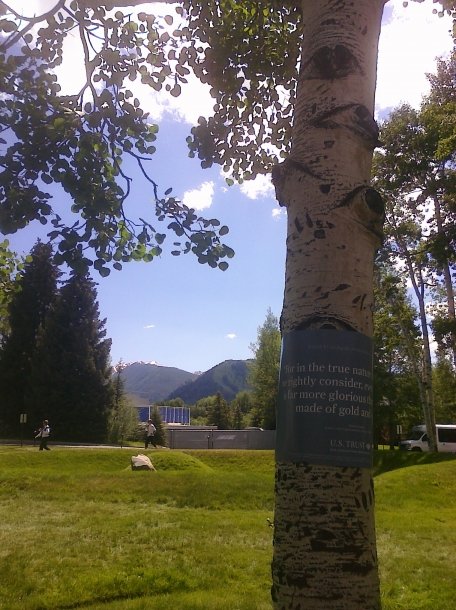
In Aspen, at the Ideas Festiva l over the summer, trees were a focus as well – emblazoned with environmental information about their important and varied roles – as the life support systems of the planet.
When I present next at the James Beard’s Foundation annual conference in New York City, on the theme of money and media in the food sector, yet again trees will not be on the menu. But they will be on the agenda – as they should and must be.
(On the first day of the conference [Oct. 12] I will be showing an excerpt from Hope in a Changing Climate in a session entitled "The Power of Effective Leadership." On the second day [Oct. 13] I will be part of the panel "DIY: Cooking up a Better Food System -- Perspectives on How We Can Affect Change" leading a session entiteld "What We Can Do with Messaging". The conference will be broadcast live and video will be available at the conclusion of the conference. For more information on the conference, see the preview in the Huffington Post--James Beard Foundation Food Conference: How Money and Media Influence the Way America Eats and the Full Conference Agenda


The Sustainability Principle
In my closing remarks at the Sustainable Food Laboratory Summit I explained….
In my closing remarks at the Sustainable Food Laboratory Summit I explained that I did not think sustainability was a goal, a metric, or even an approach to doing business. Rather, it is a principle. And it has at its core a fundamental rethinking of space and time.
Intergenerational equity – using resources today such that we don’t impair the rights of future generations to also meet their needs – is deeply in conflict with what we have come to see as the normal behavior of short-term profit maximizing corporations. That conflict is real and should not be smoothed-over or avoided.
However, for companies seeking to generate long-term value for investors, employees and the communities in which they operate sustainability is absolutely essential to success. It is in recognition of this, as I have noted elsewhere, that Unilever recently announced it was no longer issuing the seemingly sacrosanct quarterly financial report.
Over the longer term, it also becomes essential for business to manage, protect, and restore critical assets without which business will most assuredly collapse. Ecosystem assets are vital to long-term profitability.
And we now possess the tools needed to exercise this responsibility in ways that were unimaginable a few short years ago. First, the fields of resource and environmental economics have come into mainstream thinking. We understand that there is a price associated with using the carbon sequestration capabilities of the natural world. We recognize that it makes sense to pay more for the room with the ocean view than for the one overlooking the dumpster.
Second, knowledge management tools enable us to collect, analyze, understand, and share vast amounts of information about what is happening in our world – from the depths of the ocean, to ice caps, to soil moisture.
And third, we can now place this knowledge in concrete physical space, using geographic information systems.
With vast knowledge comes commensurate responsibility. As Prince Charles states at the opening of Harmony, "I don’t want my grandchildren, or yours, to come along and say to me ‘Why the Hell didn’t you do something about this? You knew what the problem was.”
(Visit TheHarmonyMovie.comfor more information on the film -- and view the Harmony Movie Trailer from Balcony Films -- courtesy of Vimeo)
Local, Sustainable and Organic
It became clear in talking with farmers, ranchers, businesspeople, chefs….
It became clear in talking with farmers, ranchers, businesspeople, chefs and public advocates during the Sustainable Food Laboratory Summit that there is a ‘goodness’ premium associated with these three linked terms. It was equally clear that few people have a clear sense of what these terms mean, beyond an evocation of being different and somehow better than conventional produce.
While there are standards that must be met before labeling food as “organic” in the United States, the range of practices that exist between conventional and organic farming is enormous and growing. No-till farming, for example, preserves soil nutrients but is widely practiced with the use of pesticides and fertilizer. Organic produce, on the other hand, can be flash-frozen and shipped around the world at enormous environmental cost. So called, “food miles” may not be the right measure of what to consume or avoid, but it surely evokes visceral concerns about what is really ‘better’ in a holistic sense.
And this search for the truly better product – something that in the United States evokes that “Mom and apple pie” feeling – has spawned an alternate universe of certification schemes. From the Rainforest Alliance, Forest Stewardship Council and UTZ Certified Good Inside; to the Roundtable on Sustainable Palm Oilcertification and hundreds of other certification mechanisms the race is well underway to meet a wary public’s desire for greater assurance that products are not only safe to consume, but also produced with minimal impact.
Some of this growth in certification is driven by distance. Few people today can practice what has for most of human existence been the most common method of certification.
Ben Stenn, however, an impassioned and talented chef at Celilo, in Hood River, Oregon, uses the tried and true method of assessing the quality of his ingredients; he visits the farmers who grow it. (Video courtesy of WinePressNW.
Since most of us cannot personally assess how farmers grow what we eat, intermediaries do it on our behalf and then crystallize what they have learned by affixing labels to what we then purchase. Witness Organic Valley’s marketing built around the core question: “Who’s Your Farmer?”
I suspect that at root (sorry!), whether searching for local, sustainable, or organic, what people are seeking is trust. As distant as we have become from the sources of our sustenance, we all still crave reassurance that we can trust the people who are selling us what we eat.
Data, Data, Everywhere
At meeting after meeting, the conversation almost always turns to metrics….
At meeting after meeting, the conversation almost always turns to metrics and data. And while we need better data and better metrics - knowing of course that we do what we measure - we also need to remember for what reasons we are collecting data. Measurement alone is not the goal.
And too often it seems to be data collection is for reporting rather than decision-making. Through sophisticated accounting systems we track cash flow, ROI, P/E ratios and a host of core financial information. And business leaders use this data to inform both operational and strategic decisions.
But if the data we have on, for example, water usage, carbon emissions, and packaging waste are only rolled-up quarterly or annually for the purpose of sustainability reporting, then how useful can they be to decision-makers? To truly imbed sustainability into corporate culture, not only do we need the metrics and data, but we need to render this information in ways that are accessible and timely for making business decisions – not just reporting them.
GreenSpace Knowledge Center Goes to Nationals Ballpark
While I was out-West last week at the Sustainable Food Laboratory Summit….
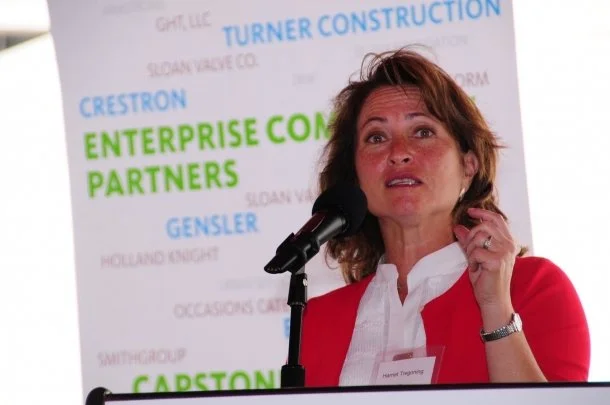
While I was out-West last week at the Sustainable Food Laboratory Summit and Aspen Ideas Festival back East in Washington, DC, a project I have been supporting for some years marked an important milestone. GreenSpace marked the opening of its new headquarters and turnkey knowledge center at Nationals Ballpark.
More than an office, more than a conference facility, more than a learning center, and more than a product demonstration venue, GreenSpace is a microcosm of the kind of community it supports throughout the national capital region. Designed without walls but with sustainable materials throughout, the space is designed, by Gensler, to be reused and redesigned without waste. It takes LEED one step further and redefines the notion of modular office space to encompass a truly mixed-use operation that is connected to and a driving force within the community.
GreenSpace founder and director, Patty Rose, embodies a new style of leadership where breaking down barriers replaces protecting ideas; where building win-win collaborations trumps competition; and were process mimics content. As the press release explains:

“Our green learning and resource center at the Nationals Park will be the place to go to build the skills, knowledge and capacity of professionals, policymakers and the public to create and retrofit ground breaking green buildings, sites and communities across the region."
For more on how GreenSpace has been driving change, in a town often criticized for being at the heart of the problem rather than the solution, see www.greenspacencr.org and its statement of goals Growing Green Communities Together (pdf).
Among the policy and sustainability leaders celebrating the launch of GreenSpace’s new facility at Nationals Ballpark last week were:



Time and Language
As children, many of us were encouraged to persevere and be somehow comforted….
As children, many of us were encouraged to persevere and be somehow comforted by the strange adage that “sticks and stones may break my bones but names will never harm me.” Not exactly. Language does matter.
Power generated from the sun streaming down on the earth today is what we have come to call solar power. But what we forget at our peril is the fossil part of fossil fuels. Oil, gas and coal are also forms of solar power; the sun just created them a very long time ago.
When I mentioned this last week at the Aspen Ideas Festival to Marvin Odum, President of Shell Oil, he seemed bemused.
Coal was formed some 300 – 400 million years ago as giant ferns and other plants died and were buried and then baked in swamps.
Also fossilized remains from hundreds of millions of years ago--likely of plankton, diatoms and other microscopic sea organisms--oil too begins with the capacity of these organisms to convert solar rays into energy.
And according to the Natural Gas Supply Association, “natural gas is a fossil fuel. Like oil and coal, this means that it is, essentially, the remains of plants and animals and microorganisms that lived millions and millions of years ago.”
As we go about the business of quickly releasing the carbon dioxide and methane that mother nature took hundreds of millions of years to carefully sequester, we would do well to remember that time, like geology, is a very powerful force. How we come to understand time and its many meanings has huge impact on how we see the world and the challenges we face. (And more on that in upcoming dispatches.)
For example, the Co-Founder of Wired Magazine, Kevin Kelly, recast the seeming universality and permanence of today’s social media technologies at a fascinating session with Sherry Turkle (Director of the MIT Initiative on Technology and Self) last week at the Aspen Ideas Festival. His calm observation that the web is about 8,000 days old reframed the entire discussion.
What seems fixed today, is sure to change tomorrow. Unless of course we are talking about rocks or the deep underlying natural processes that support life on planet earth.
To Aggregate or Segregate – Is That The Question?
Amidst a host of rich and deep discussions at the Sustainable Food Laboratory summit….
Amidst a host of rich and deep discussions at the Sustainable Food Laboratory summit this week in Oregon, we kept coming back again and again to a few underlying themes. The complex relationships among commodities, organic produce, price, and brand value was one of these touchstone issues.
Given the current structure of food and agriculture markets, organic costs more – across the entire supply chain from farm to table. Depending on the type of food, some of this added cost comes from the need to certify, track, and move products through distribution networks that are parallel with but not quite the same as the networks for conventionally grown products. In this regard, organic is segregated from mainstream produce.
Some consumers accustomed to paying lower prices for conventional food are increasingly willing to pay a premium for the value of ensuring that what they eat is closer to pure and unadulterated food. And businesses are eager to build brand equity, trust, loyalty, and gain access to this still small but rapidly growing market.
But if organic agriculture aims to ‘go mainstream,’ when does a segregated and ‘special’ product itself become a commodity? And if it does, does it thus transform and redefine the commodity market? “Mainstream,” implying a majority of consumers, may be less the issue than knowing what it takes to shift standard industry practice to a new level. And more on that shortly.

Dave Brewer, Emerson Dell Farm, explains his use of new seeding techniques to an international delegation of business and NGO leaders participating in the Sustainable Food Laboratory summit outside Portland, Oregon.
A Conversation with Bill Clinton about Climate
Having heard President Clinton speak a few times while he was President….
Having heard President Clinton speak a few times while he was President, it was inspiring to have a conversation with him on Saturday (July 2) after his unscheduled presentation at the Aspen Ideas Festival

A handful of us were talking after listening to his view of the 2012 election: Obama Administration success stories, observations on the Republican field, and calculations regarding Hispanic votes. I then solicited his thoughts on climate. He had just explained the critical importance of generating and managing uncertainty as a tool for political power.
I asked if he thought this ‘uncertainty principle’ could also be applied to generate support for successful climate and energy policy. After a brief pause, as his famous piercing blue eyes narrowed slightly, he said, “yes, I do.” He talked quickly and intensely about the importance of a single line in the stimulus legislation that Republican leaders have targeted. The fight is over $2 billion that has helped jump-start electric-vehicle battery manufacturing in the United States. (According to DOE, the 26 plants now operating will have capacity to meet 20 percent of global market demand in 2012).
A passionate advocate for aligning economic growth, “green jobs” and reducing carbon, Clinton then looked around, lowered his voice and leaned in to speak with the four of us in a huddle (perhaps because Chris Matthews and Gov. Haley Barbour of Mississippi might otherwise have overheard his next point). Pointing again to the new jobs created in the automobile battery sector with federal support over the last 18 months, he said “and they are worried that we really will generate the jobs with these investments…and that’s why they killed it.” He then raised his eyebrows evocatively, “Got it?”
We then shook hands with the 42nd President of the United States, as he thanked us for coming and for the questions we posed. With nothing to gain and no votes to solicit, Bill Clinton still left us all feeling that we had had a few moments with one of the truly commanding leaders of our age.
Geology and The Bottom-Line
Hannah Jones, VP of Sustainable Business and Innovation at Nike….
Hannah Jones, VP of Sustainable Business and Innovation at Nike, had the most memorable lines among dozens of speakers at two recent conferences, the “Ceres Conference 2011: Igniting Innovation, Scaling Sustainability” and The Conference Board’s “Corporate Citizenship and Sustainability” gathering in Washington, DC. Hundreds of senior executives from America’s leading corporations exploring urgent questions of climate stability, water resources, sustainable agriculture, and innovation and entrepreneurship. But Jones stole the show with two powerful remarks. Knitting together transparency, a key metric for responsible corporate reporting, with core business performance, she quipped that “if you’re going to be naked you better be buff!”
At a more granular level, we learned why SAP, in a small but significant shift, now releases financial results with its sustainability report, forcing a common language across the NGO and financial communities. If you want to see SAP’s carbon footprint you cannot escape their profit and loss statement; and if you are looking for their operating margin you also come face to face with “total energy consumed.”
We also reengaged what I see as an increasingly tired question -- is there “a business case for sustainability?” Do companies ‘do sustainability’ to make money, to reduce costs, or to enhance license to operate, brand equity, and to retain new and younger employees who want to feel good about their work every day? We heard powerful examples of business growth, market opportunities created, and profits generated from embedding sustainability in corporate DNA and also using it as a lens to drive innovation.
But – and it is a big but – it seems to me that the way we have framed this debate diverts us from the core sustainability challenge. And that is how we think about time. There is a disconnect between the incentivized behaviors of short-term profit-maximizing corporations and the increasingly bold proclamations by corporate leaders that their organizations will increasingly act with the interests of intergenerational equity at the forefront of strategy, planning and business operations.
Whether the fossil fuels we use to generate electricity, water to make myriad food products, or trees for desks and paper; all of the natural resources (including atmospheric gases) that we use to make products (or hold industrial “wastes,” like carbon) exist across a geologic time-scale measured in hundreds of millions of years. Three-year ROIs and quarterly earnings reports are but microscopic specks of dust across, for example, the 350,000,000 million years during which coal was formed from giant plants that died long before the dinosaurs.
When we ask (and ask and ask!) that sustainability justify itself on the altar of modern-day market capitalism, is this not a bit like arguing with a lump of coal over its own formation? We, rather than the coal, are the newcomers; who says it needs to explain itself to us? Coal is surely not going to adjust to our short-term needs. The core question is thus not about the business case for sustainability but rather the lack of a sustainability case for short-term profit maximizing behavior.
Done right, over a time-scale that accommodates both geology and the bottom-line, human ingenuity and nature’s incredible diversity and robustness can likely find a harmonious synergy. But this will take real leadership.
Who among the leaders of the Fortune 500 wants to tackle this issue of time and link his or her compensation equally to sustainability performance and profits by insisting that compensation be reviewed on a three-year basis across an integrated bottom line? Who at the SEC wants to lead the charge to bring corporate oversight out of the 19th century and into the 21st century by moving beyond limited reporting of climate risk to helping figure out how to bring trillions of dollars of environmental externalities onto the books of our nation’s corporations?
Hannah Jones also noted that at Nike, “we are measured against our potential.” Who among our corporate leaders today has the courage to just ….?
Leaders Today
Leaders today can little afford to be mere experts….
Leaders today can little afford to be mere experts. Effective decision-making demands of leaders that we move fluidly and confidently across issues rather than be constrained by what we know. Making decisions with access to all the information required is easy. But leadership is about making the right decision in the face of limited or conflicting information.
How can we see over the horizon to plan for emerging issues before they impact the bottom line?
When traditional research approaches aren’t helping clarify a decision, what outside-the-box approaches will help?
If we do what we measure, but we are not fundamentally in the business of sustainability, how de we embed metrics that make sense?
How do we drive change, and preserve our organizational identify?
What’s the effective way to asses an NGO/Corporate partnership to see if it really makes sense?
Whether we term it marketing or outreach, how do we effectively engage citizens (or consumers) beyond those that already know us and support us?
Call it sales, call it advocacy; we are all in the business of communications. And reaching across traditional divides is critical to addressing the great challenges of our age.
There is no such thing as climate policy without energy policy. Without addressing poverty, sustainable agriculture will never reach its promise of feeding not only this but also the next generation. Water issues are central to political, financial, health, and geographic realities and possibilities.
A Hospital without Patient Safety?
Corporate responsibility is to the management of a company what patient safety….
Corporate responsibility is to the management of a company what patient safety is to the administration of a hospital. If you are not doing it, what are you doing?
But as the concept of corporate responsibility has expanded beyond it initial construct of corporate social responsibility, so too the early focus on transparency, reporting, metrics and monitoring leaves much of this work outside the core business of business. Who would go into a hospital for surgery if we knew in advance that there were only, say, seven people working on patient safety while the rest worked on… what?
So for all the good that CR has done and is doing, in too many organizations the issues remain peripheral – small teams of dedicated people, sometimes with the ear of the CEO, pushing nudging the core business into incremental changes. Like tugboats working with a tanker, we often remain far from the engine room of power, profit, decision-making, and prestige.
Whether an executive, a stakeholder, a shareholder, or a CR professional we must confront the reality of popular fiction. Corporate structure is a figment of our legal and cultural imagination. Phenomenally effective at generating economic growth and the stuff that we all use and discard, and this engine has been one of prosperity for many millions of people, so too has this imaginative structure enshrined a set of incentives that all too often set people against one another. Short-term profit maximizing behavior clearly has denuded forests and stripped mountaintops bare. Long-term social development and cultural unity has often frayed as corporate institutions excel. Incumbents use market power to stifle innovation, even though they were yesterday’s innovators.
We know what CR looks like today, but tomorrow?
Are you Handling or Mishandling the Climate Challenge?
The issue of our time is framed for failure….
The issue of our time is framed for failure. Climate change is the norm and everyone experiences it daily; the weather changes. Climate stability, however, is the goal – for people, business, and global ecosystems. We need predictable climatic conditions to make good decisions – whether to make major capital investments or whether to carry an umbrella.
And the climate is not an environmental issue but rather the connective tissue that ties energy together with business, development and poverty with agriculture, and health with the environment. No mere question of semantics, the fundamental definition of the challenge has immense impact on how we work to develop solutions.
The challenge is not fundamentally science, finance, or even policy. Rather, we lack the thinking and the institutions capable of effectively responding to an issue that cuts across so many traditionally distinct areas of expertise – especially when compounded by issues of risk allocation and intergenerational financial equity.
Are you handling or mishandling the climate challenge?
Going on Three Decades
Difficult to manage, impossible to avoid, and the endless driver of opportunity….
Difficult to manage, impossible to avoid, and the endless driver of opportunity, driving and managing changehas been at the core of my work going on three decades. Living and working in Moscow as the Berlin Wall collapsed, guiding senior Western business executive through the splintering of the Soviet Union, and mapping the massive social, political, and global economic changes brought forth by perestroika and glasnost I experienced the turmoil and opportunity of profound change.
The dynamic process through which organizations and individuals act and react has much in common with the interaction of organisms and the natural balance of our globally linked ecosystems. As evolution happens every moment, but cannot be seen except across millennia, the power of entrenched thinking, cultural norms, and infrastructure cannot be swept aside in a moment. Yet, disruptive change happens; incumbent players are toppled and a new order emerges.
As nature abhors a vacuum and water flows until stopped, so too information floods our world – much of it incomplete, inaccurate, or manipulated to suit the needs of one actor at the expense of another.
Whether through research and strategy development or the execution of communications programs, I honed a unique mix of skills enabling me to work effectively at the intersection points where organizations tend to stumble and where high level yet narrow expertise often proves an obstacle to original thinking and the capacity to see opportunities in challenge. Not easily pegged I work in the white space, across and between neatly delineated departments and functions on organizational charts.
Whether presenting at a trade conference, driving a strategic brainstorming session, creating new means of communications, or providing one-on-one counsel to nonprofit or business leaders, my work is firmly grounded in how things are today – and how they might be in a better world tomorrow.